The Most Common Household Preparedness Mistakes
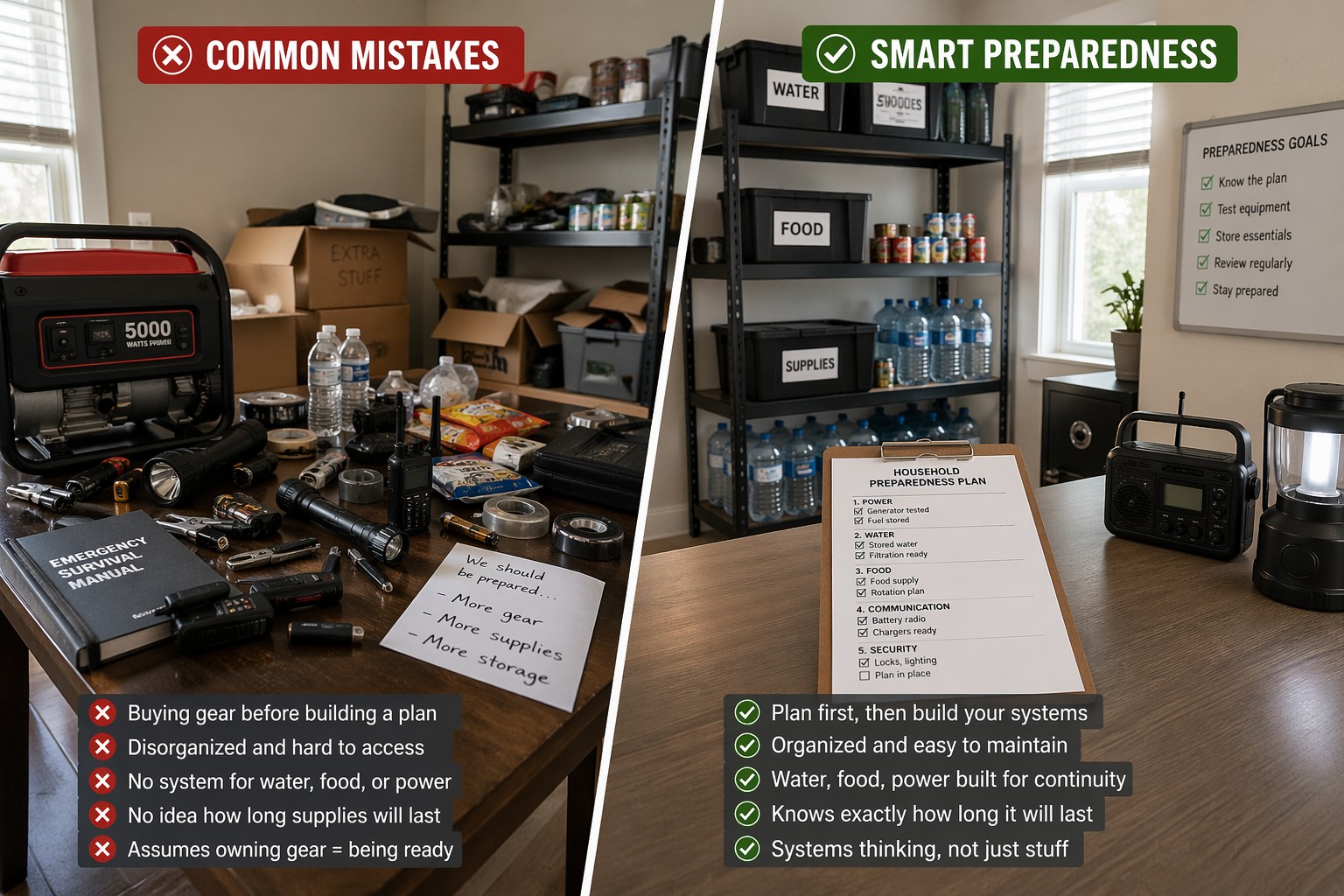
Most households do not fail because they ignore preparedness completely—they fail because they prepare in the wrong order. Money gets spent on visible gear while the systems that create the fastest instability remain weak. A generator is purchased before water storage is secured. Security equipment is added before communication plans exist.
Preparedness works best when households understand what actually causes failure. The goal is not to own more supplies. It is to remove the mistakes that turn short disruptions into expensive, preventable household problems.
Most preparedness mistakes come from confusing visible progress with real readiness. Buying equipment feels productive, but preparedness is measured by whether power, water, food, communication, and security systems continue functioning when normal routines fail. Weak planning hidden behind expensive gear creates false confidence and fast instability.
The strongest households focus on preventing failure, not collecting supplies. Understanding the most common mistakes makes every future decision stronger because resources are spent where continuity actually improves.
Mistake #1 — Buying Gear Before Building a System
Many households mistake buying gear for becoming prepared. Generators, radios, water filters, and security equipment feel like progress because they are visible purchases. But if those tools are not connected to a real household plan, they often create false confidence instead of actual readiness.
A generator without fuel discipline is temporary comfort. Stored food without water planning creates a different failure. Security gear without communication routines does not protect household stability. Preparedness works when systems support each other, not when random equipment fills storage shelves.
What Correct System Planning Looks Like
Correct preparedness starts by identifying which system fails first, not which product looks most useful. Households should begin with water access, refrigeration protection, backup lighting, communication reliability, and safe household routines before expanding into larger purchases.
Every purchase should answer a system problem. If a generator is added, fuel discipline and critical load planning must already exist. If food storage expands, water and cooking continuity must support it. Preparedness becomes strong when each improvement strengthens the entire household instead of creating isolated weak points.
Mistake #2 — Solving Comfort Before Stability
Many households respond to outages by trying to restore normal comfort instead of protecting the systems that create real stability. Running backup power for televisions, internet convenience, or nonessential appliances feels productive, but it often wastes fuel and attention while refrigeration, water access, medications, and communication planning remain vulnerable.
Preparedness works best when households separate inconvenience from consequence. Comfort can wait. Stability cannot. The goal is to protect the systems that prevent fast household failure, not recreate normal life on Day One.
How to Separate Inconvenience From Real Risk
Internet loss feels urgent because it disrupts work and routines, but losing reliable drinking water creates true household instability much faster. A warming refrigerator feels expensive, but uncontrolled generator use can create a larger failure when fuel runs out too early. Prepared households evaluate what causes system failure first, not what feels most annoying.
The correct question is simple: If this problem continues for three more days, what fails next? That question exposes whether the issue is discomfort or a true continuity threat. Strong preparedness protects what breaks the household first.
Mistake #3 — Assuming Short Outages Stay Short
Many households delay conservation because they assume power, water, or normal services will return quickly. That assumption causes some of the most expensive failures—fuel gets wasted, refrigerated food is lost, water reserves drop too fast, and communication planning never happens because people keep waiting for “normal” to return.
Preparedness improves when households plan for uncertainty instead of optimistic timelines. If restoration estimates are unclear, resources are dropping faster than expected, or daily routines can no longer be maintained safely, the response must shift immediately from temporary inconvenience to continuity planning.
The Real Decision Point
The most important question is not “When will power come back?” but “Can this household continue functioning if it does not?” That decision changes fuel use, food strategy, water conservation, transportation planning, and whether outside support becomes necessary.
Prepared households shift strategy early. They stop treating restoration like a guarantee and begin protecting continuity while resources still exist. A common mistake is waiting for certainty before changing behavior. By the time certainty arrives, the avoidable losses have usually already happened.
Mistake #4 — No Communication Plan
Many households assume phones are the communication plan. When power outages, network congestion, storms, or evacuation pressure affect normal connectivity, that assumption fails quickly. Confusion increases, family members make independent decisions, and small problems become larger because nobody knows the actual plan.
Preparedness requires communication before disruption, not during it. Households should know who needs contact first, where to meet if normal communication fails, how devices stay charged, and what backup communication options exist if normal networks become unreliable.
Communication Fails Quietly First
Communication problems rarely begin with total silence. They start with low batteries, missed messages, weak charging routines, outdated contact information, and assumptions that everyone “already knows the plan.” These small failures create confusion long before complete communication failure happens.
Prepared households use written contacts, simple check-in routines, backup charging discipline, and clear household expectations before disruption begins. A common mistake is treating communication like convenience instead of continuity. By the time phones stop working, the planning window is already gone.
Mistake #5 — Confusing Security With Gear
Many households treat security like a shopping list—cameras, locks, lights, and equipment—while ignoring the routines that actually protect stability. During outages and disruptions, most security failures begin with disorder inside the home: poor access control, unclear expectations, inconsistent lighting routines, and weak communication.
Preparedness works best when security starts with household management. Visibility, predictable routines, controlled access points, and clear family expectations prevent more problems than hardware alone. Equipment supports stability, but routine creates it.
Stability Before Hardware
Strong household security starts with routine, not purchases. Exterior lighting, controlled access points, predictable evening habits, and clear household expectations reduce confusion and prevent small problems from escalating during disruption. These systems work even when power is limited or outside help is unavailable.
A common mistake is buying visible security equipment before fixing simple management failures inside the home. Prepared households protect stability first because order prevents more risk than panic-driven upgrades ever will.
Return to Household Preparedness Systems