How to Prioritize Household Systems During a Disruption
Most households make preparedness harder than it needs to be because they try to solve everything at once. During a disruption, not every problem carries the same level of risk. Power, water, food, communication, and security must be handled in the right order if a household is going to stay stable and avoid preventable failures.
Preparedness works best when systems are prioritized by consequence, not convenience. The goal is not to own more gear—it is to protect the functions that keep the home operating when normal routines break down.
A structured household response starts by identifying which failures create immediate instability and which problems can wait. Losing refrigeration is different from losing internet. Water access is different from delayed deliveries. Strong preparedness means knowing what must be protected first so time, money, and energy are used where they matter most.
Prioritization prevents panic spending, poor decisions, and wasted effort. Households that understand system order respond faster, preserve resources longer, and maintain far more stability during extended disruptions.
Why Prioritization Matters
Most preparedness failures happen because households respond to inconvenience instead of consequence. People often spend money solving visible problems first while ignoring the systems that create the fastest instability. A dead freezer, low water reserves, or failed communication plan creates far more risk than delayed internet access or household comfort.
Prioritization protects stability. When households understand which systems fail first and which failures create cascading problems, they make better decisions, preserve resources longer, and avoid expensive mistakes during disruption.
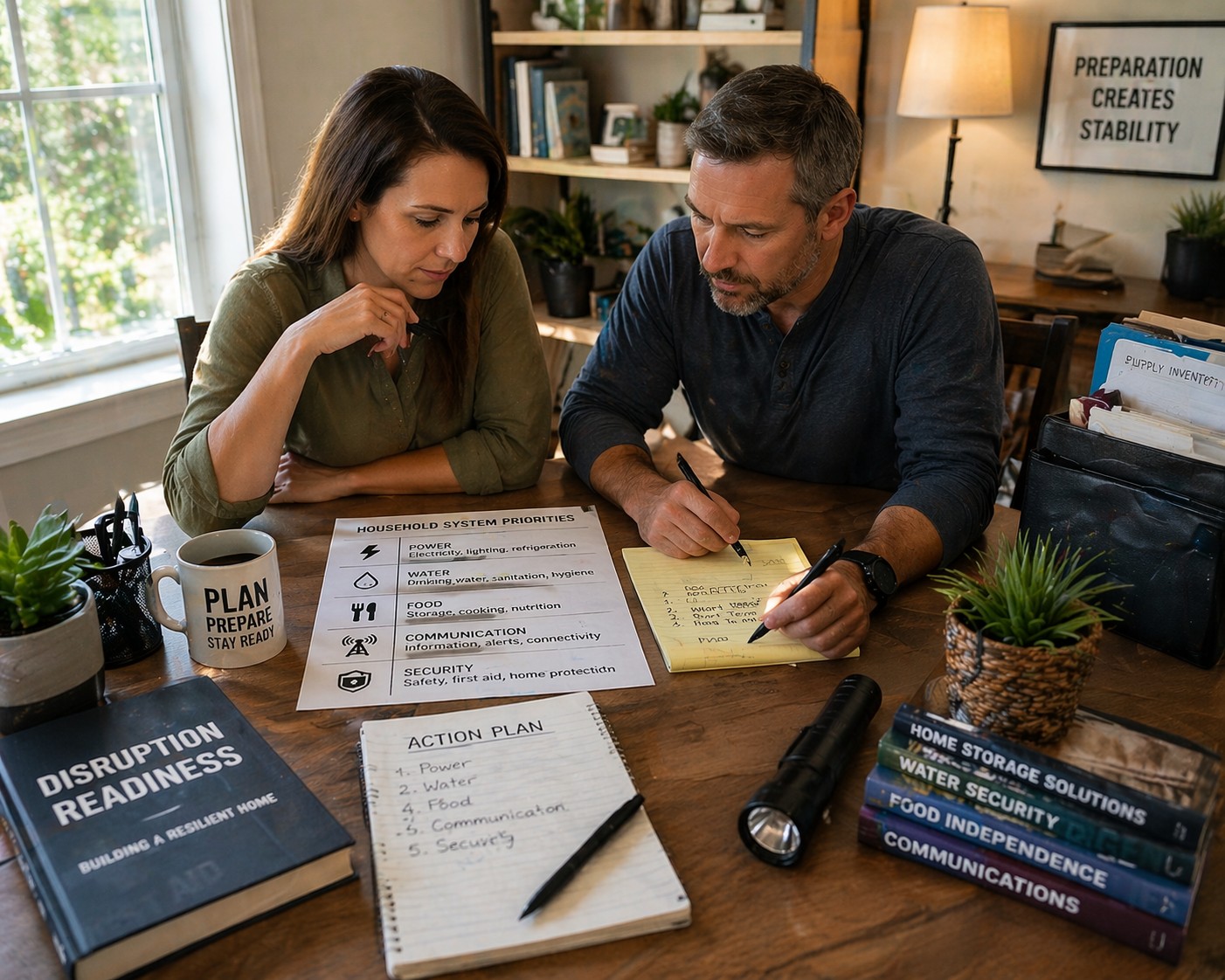
Most households should prioritize systems in this order:
- Power stability
- Water access
- Food continuity
- Communication reliability
- Security and household routine
This order is based on consequence, not convenience. Systems that create immediate household instability must be protected before comfort, upgrades, or nonessential purchases.
The exact order may shift depending on weather, medical needs, household size, and outage type, but the goal remains the same: protect the systems that keep the home functioning first.
What Changes the Priority Order
The priority order is not rigid in every situation. Household conditions can change which system becomes urgent first. Medical dependency, extreme heat, freezing weather, infants, elderly family members, and limited stored resources can all shift what must be protected immediately.
The goal is not to memorize a fixed list but to understand why one system rises above another. Good preparedness means adapting the order without losing the logic behind it.
Extreme Heat or Freezing Weather
During extreme heat or freezing conditions, power stability often becomes the immediate priority because temperature control affects safety, medication storage, food preservation, and water reliability. In these situations, household survival depends more on environmental control than convenience.
If cooling or heating failure creates direct health risk, households should prioritize temperature stability before normal comfort routines. Refrigeration may matter less than preventing dangerous indoor heat or freezing exposure for children, elderly family members, pets, or medical needs.
A common mistake is assuming outages can be managed normally for “just one more day.” In temperature extremes, waiting too long to protect the home often creates faster failure than the outage itself. Sometimes temporary relocation is safer than trying to force the home to function beyond safe limits.
Medical Needs in the Home
Households with refrigerated medications, oxygen equipment, mobility limitations, medical devices, or other health dependencies may need to prioritize power and communication before every other system. Preparedness must protect people first, not generic checklists.
If medication storage, powered medical equipment, or transportation access becomes unstable, the response order changes immediately. Backup power, refrigeration, charging, transportation options, and emergency contact plans become critical before food convenience or normal household routines.
A common mistake is treating medical dependency like a secondary issue instead of the primary planning factor. In many homes, the real first priority is not the outage itself—it is protecting the people whose safety depends on systems continuing to function.
Low Water Reserves
If stored drinking water is already limited, water access may move above power as the first priority. Water failure creates fast instability, and households that delay conservation often create larger problems within days.
When reliable refill options are uncertain, households should immediately shift from normal usage habits to controlled conservation. Drinking, cooking, sanitation, and hygiene all compete for the same limited resource, and poor planning can drain reserves faster than expected.
A common mistake is waiting until water feels critically low before changing behavior. Strong preparedness starts conservation early, protects filtration options, and treats water as a continuity system—not just a backup supply sitting on a shelf.
Security Conditions
Extended outages, civil unrest, evacuation pressure, or rural isolation may move security higher in the response order. Security is not about fear—it is about protecting household stability, access control, and predictable routines when normal systems become unreliable.
If outages extend beyond normal routines, households should shift from casual habits to deliberate access control, lighting management, and clear household expectations. Small failures like poor exterior lighting, unsecured access points, or inconsistent routines often create more problems than outside threats themselves.
A common mistake is treating security as either panic-driven defense or ignoring it completely. Strong preparedness focuses first on stability, visibility, and predictable routines that reduce confusion and prevent small problems from escalating.
Common Mistakes in Household Prioritization
Many households create bigger problems by responding to inconvenience instead of consequence. People often spend money solving visible frustrations first while ignoring the systems that create the fastest instability. Backup generators get purchased before water storage is secured. Security gear gets prioritized before communication plans exist.
Preparedness works best when households protect system continuity first. The goal is not to solve every problem at once, but to prevent the failures that create the fastest household instability and the most expensive recovery later.
Common mistakes to avoid:
- Solving comfort problems before stability problems
- Buying equipment before identifying actual household weaknesses
- Treating power loss as the only priority when water or medical needs are more urgent
- Waiting too long to conserve fuel, water, or refrigerated food
- Confusing visible inconvenience with true system failure
- Ignoring communication planning until normal networks become unreliable
Example: Small Problem vs System Failure
Many households respond fastest to what feels annoying instead of what creates real instability. A freezer warming up, low water reserves, or a failed family communication plan may look less urgent than internet loss or general inconvenience, but those system failures create far greater long-term problems.
Preparedness improves when households learn to separate discomfort from true operational risk. Small frustrations can wait. System failures cannot.
Internet Down vs Water Loss
Losing internet feels urgent because it disrupts work, routines, entertainment, and normal communication. People react quickly because inconvenience feels immediate. But losing reliable drinking water creates true household instability far faster. Water affects health, cooking, sanitation, hygiene, and every other daily function.
The correct decision is to solve water first and inconvenience second. If stored drinking water is limited, conservation and refill planning must begin immediately—even if internet access feels like the bigger problem. A common mistake is spending time restoring comfort while ignoring the system that creates the fastest failure.
Prepared households protect continuity first and convenience later.
Warm Refrigerator vs Fuel Waste
A warming refrigerator feels urgent because food loss is visible, expensive, and immediate. That often pushes households into running backup power without a plan. But uncontrolled generator use can create a larger failure when fuel is wasted too early and no longer available for refrigeration, lighting, communication, or medical needs later.
The correct decision is to protect critical loads with controlled fuel use, not to recreate normal convenience. If fuel sustainability is uncertain, households should immediately shift from “keep everything running” to preserving the highest-risk systems first. A common mistake is treating generator capacity like comfort power instead of continuity power.
Prepared households manage fuel as a limited resource, not a short-term convenience tool.
Security Gear vs Household Routine
Many households focus on visible security purchases before establishing simple routines like lighting control, access awareness, household communication plans, and predictable evening routines. Equipment feels like progress, but disorder inside the home often creates more risk than outside threats.
The correct decision is to protect stability first. Clear routines, controlled access points, exterior lighting, and consistent household expectations reduce confusion and prevent small problems from escalating during outages. A common mistake is treating security as hardware instead of household management.
Preparedness works best when stability comes before gear.
Return to Household Preparedness Systems