How Much Water To Store For Emergencies
Knowing how much water to store for emergencies starts with a simple baseline, but the real answer depends on your household. People, pets, cooking, hygiene, climate, medical needs, storage space, and the length of the disruption all affect the final number. A good water plan is not just a pile of gallons. It is enough usable water, stored in the right places, for the people who actually live in the house.
This guide gives you a practical way to calculate emergency water storage needs, starting with the one-gallon-per-person-per-day baseline and then adjusting for pets, cooking, hygiene, heat, health needs, sanitation, and the difference between a short outage and a longer disruption.
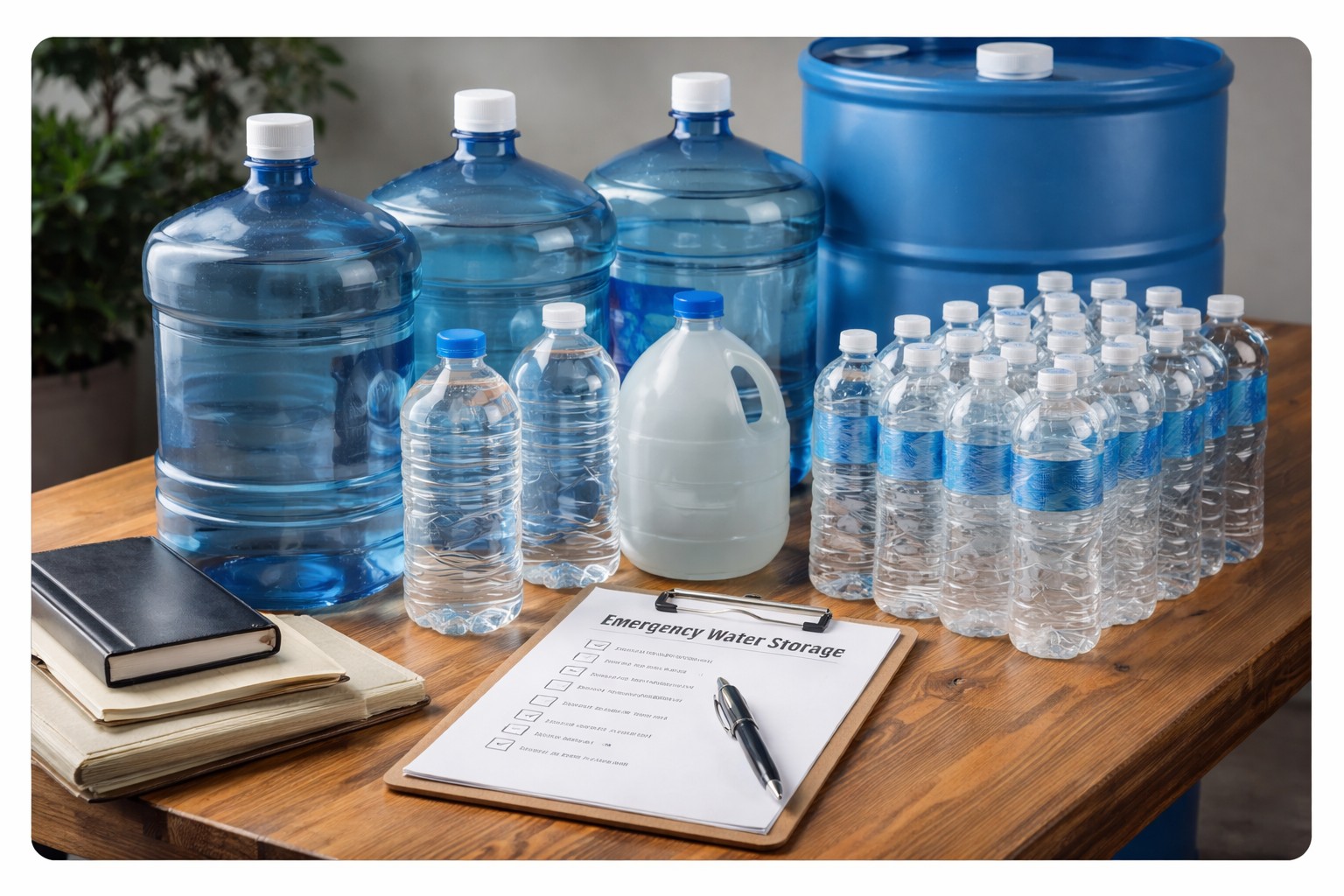
How Much Water to Store for Emergencies: 1 Gallon Per Person Per Day
The basic emergency water storage rule is at least one gallon of water per person per day. That amount is meant to cover drinking and very limited basic needs during a short disruption. It is a starting point, not a complete household water plan. Real households may need more once pets, cooking, heat, medical needs, hygiene, and sanitation are included.
One Gallon Per Person Per Day
For basic emergency planning, one gallon per person per day is the minimum number to start with. A two-person household needs at least two gallons per day. A four-person household needs at least four gallons per day. That sounds manageable until you multiply it across several days and then add pets, cooking, hygiene, and the fact that emergencies rarely arrive at a convenient temperature.
Three Days Is the Minimum Starting Point
A three-day supply is the minimum emergency water reserve most households should build first. At one gallon per person per day, that means 3 gallons for one person, 6 gallons for two people, 12 gallons for four people, and 18 gallons for six people. This gives the household a basic buffer for short outages, boil-water notices, storms, and temporary service interruptions.
Two Weeks Is a Stronger Household Target
Once the three-day minimum is covered, a two-week supply is a stronger target for households that have the space and containers to support it. At one gallon per person per day, that means 14 gallons for one person, 28 gallons for two people, 56 gallons for four people, and 84 gallons for six people. That is a lot of water, but it gives the household more room to handle delayed repairs, contaminated supply, extended outages, or bad timing from the universe, which has never been known for scheduling politely.
How to Calculate Your Household Water Storage Needs
Use a simple formula first, then adjust it for real life: people × days × gallons per day. Start with one gallon per person per day, multiply by the number of people in the household, then multiply by the number of days you want to cover. After that, add extra water for pets, cooking, hygiene, heat, health needs, and stored foods that require water.
Basic Water Storage Formula
Number of people × number of days × 1 gallon = minimum stored water
For example, a four-person household planning for seven days would calculate: 4 people × 7 days × 1 gallon = 28 gallons of stored water. That number covers the basic minimum. It does not yet include pets, extra cooking water, hygiene, hot weather, medical needs, or extra margin.
Example Storage Targets by Household Size
Use these numbers as minimum planning targets based on one gallon per person per day:
| Household Size | 3 Days | 7 Days | 14 Days |
|---|---|---|---|
| 1 person | 3 gallons | 7 gallons | 14 gallons |
| 2 people | 6 gallons | 14 gallons | 28 gallons |
| 3 people | 9 gallons | 21 gallons | 42 gallons |
| 4 people | 12 gallons | 28 gallons | 56 gallons |
| 5 people | 15 gallons | 35 gallons | 70 gallons |
| 6 people | 18 gallons | 42 gallons | 84 gallons |
These numbers are the floor, not the ceiling. They do not include pets, cooking, hygiene, medical needs, hot weather, or extra margin.
Add a Safety Margin
After calculating the minimum amount, add a safety margin if space and budget allow. Extra water helps cover hot weather, illness, cleanup, pets, unexpected guests, longer outages, and the small daily uses people forget to count. A 10–25 percent margin is a practical starting point for many households. Water runs out faster when everyone is tired, sweaty, or trying to wash hands with a measuring cup.
What Increases How Much Water You Need to Store?
The one-gallon-per-person rule is useful because it gives you a starting number, but some households need more. Climate, activity level, pets, medical needs, infants, stored food choices, hygiene, sanitation, and outage length can all raise the real amount of water needed. This is where a basic emergency water number becomes a household-specific plan.
Pets and Service Animals
Pets and service animals need their own stored water. The amount depends on the animal’s size, diet, activity, temperature, and health needs, so do not assume household water for people will be enough. Add a separate pet water allowance to your calculation and store it where feeding supplies, carriers, leashes, medications, or pet emergency items are easy to reach.
Hot Weather and Physical Work
Heat and physical work increase water needs quickly. Hot climates, summer outages, cleanup work, outdoor repairs, generator setup, storm recovery, and heavy sweating can all push a household beyond the basic one-gallon-per-person baseline. If your emergency plan assumes people will be moving, lifting, repairing, cooking, or sleeping in a warm house, store extra water before you need it.
Infants, Older Adults, and Medical Needs
Infants, older adults, and people with medical needs may require more water than a simple household average suggests. Formula preparation, medication routines, wound care, hygiene, cooling, humidification, and medical equipment cleanup can all increase demand. If someone in the household depends on clean water for health, do not treat their needs as an afterthought in the calculation.
Cooking and Dry Emergency Foods
Stored food affects stored water. Rice, pasta, oats, beans, powdered milk, dehydrated meals, drink mixes, and basic cleanup all require water in some form. If your emergency food plan depends heavily on dry staples or powdered foods, add water for cooking and preparation. A pantry full of dry food and not enough water is not a complete plan. It is homework with calories.
Hygiene and Basic Sanitation
Drinking water gets most of the attention, but hygiene and sanitation use water too. Handwashing, basic dish cleanup, sponge baths, toilet flushing, surface cleaning, and laundry emergencies can all draw from stored supplies if normal water service is interrupted. Not all sanitation water has to be drinking-quality water, but the need still has to be planned.
Short-Term vs Longer Emergency Water Storage
A short-term water supply is built to get a household through the first few days of disruption. A longer emergency water supply gives more breathing room if repairs are delayed, roads are blocked, contamination affects the local system, or normal service comes back slowly. The right target depends on your household size, storage space, local risks, and how much disruption you are trying to absorb without scrambling.
Start With a Three-Day Minimum
A three-day supply is the first target because it gives the household an immediate buffer for short outages, boil-water notices, storms, service interruptions, or temporary contamination. It is not the final goal for every household, but it is the first useful line to cross. Get the minimum in place before worrying about a perfect long-term setup.
Build Toward a Two-Week Supply
A two-week supply is a stronger target once the three-day minimum is covered. It gives the household more time if local repairs are delayed, stores are closed, water quality is uncertain, or normal service returns slowly. Not every household can store two full weeks immediately, but building toward it one container at a time is a practical long-term goal.
Stored Water, Filtration, and Backup Sources Are Not the Same Thing
Stored water is water the household can use immediately. Filtration and purification help make questionable water safer. Backup sources, such as rain collection, wells, nearby surface water, or municipal refill points, may provide additional options. These are related parts of a water plan, but they are not interchangeable. Stored water buys time when everything else is uncertain.
Store First, Filter Second
Do not treat a water filter as a replacement for stored water. A filter is useful only if you have a water source to run through it, enough time to use it, and conditions that make collection safe. Stored water should be the first layer because it is already available inside the home. Filtration is the backup layer that helps extend the plan when stored reserves run low or outside water becomes part of the equation.
Do Not Count Untreated Water as Ready Water
Rain barrels, pools, streams, ponds, wells, and collected runoff may become useful backup sources, but untreated water should not be counted the same way as stored drinking water. If water needs filtering, boiling, disinfecting, testing, or hauling before use, it belongs in the backup-source part of the plan, not the ready-to-drink supply. Counting it too early makes the household look better prepared on paper than it is in the kitchen.
Common Water Storage Mistakes to Avoid
Most water storage problems come from planning around a number instead of a working household system. A household may store the right number of gallons and still run into trouble if the water is hard to reach, stored in the wrong place, not rotated, tied up in containers that cannot be moved, or counted as usable before it has been treated.
Storing Only the Bare Minimum
The minimum amount is useful because it gives you a starting line, but it should not become the finish line if your household has room to store more. Bare-minimum water storage leaves very little margin for heat, illness, pets, cleanup, cooking, or delays. Build the three-day supply first, then add extra capacity as space, containers, and budget allow.
Forgetting Water for Pets and Hygiene
People often calculate drinking water and stop there. Pets, handwashing, dish cleanup, sponge baths, toilet needs, and basic sanitation can all require additional water. If those needs are not included, the stored supply may look adequate until the first messy, hot, inconvenient day proves otherwise.
Counting Untreated Water Too Soon
Untreated water from rain barrels, pools, streams, wells, or nearby sources may be useful later, but it should not be counted as ready emergency drinking water until it has been properly filtered, disinfected, or otherwise made safe. Stored drinking water is the immediate reserve. Untreated backup water is a separate layer that needs tools, time, and judgment.
Storing Water Where It Cannot Be Reached
Stored water should be accessible enough to inspect, rotate, and use. Water buried behind heavy boxes, seasonal decorations, tools, or furniture may technically be stored, but it is not practical. Keep at least part of the household supply where it can be reached quickly, especially the first few days of drinking water. Emergency supplies should not require a furniture-moving crew.
Where This Fits in Your Water Systems Plan
Knowing how much water to store is the quantity layer of the Water Systems plan. Once the household target is clear, the next decisions are container type, storage location, rotation, filtration, purification, and backup sources. The number matters, but it only works when the water is stored safely, reachable when needed, and connected to the rest of the household preparedness system.
Return to Water Systems to continue building your household water preparedness plan.