When to Stay Home vs When to Leave During a Crisis
One of the most important household preparedness decisions is knowing when staying home is safer than leaving—and when leaving early is the smarter choice. Many families wait too long because normal routines create false confidence, while others evacuate too quickly without understanding whether the home could have remained stable.
Strong preparedness is not built around fear or rigid rules. It is built around clear decision-making. The goal is to evaluate power, water, food, communication, security, medical needs, and outside conditions early enough to choose from stability instead of panic.
Most households fail this decision because they ask the wrong question. Instead of asking “Should we leave right now?” they should ask “Can this home safely continue functioning if conditions get worse?” That shift changes everything. It moves the decision from emotion to system evaluation.
Leaving too late creates dangerous exits. Leaving too early can waste resources, separate families, and abandon a stable home unnecessarily. Prepared households identify the decision points before crisis pressure removes good options.
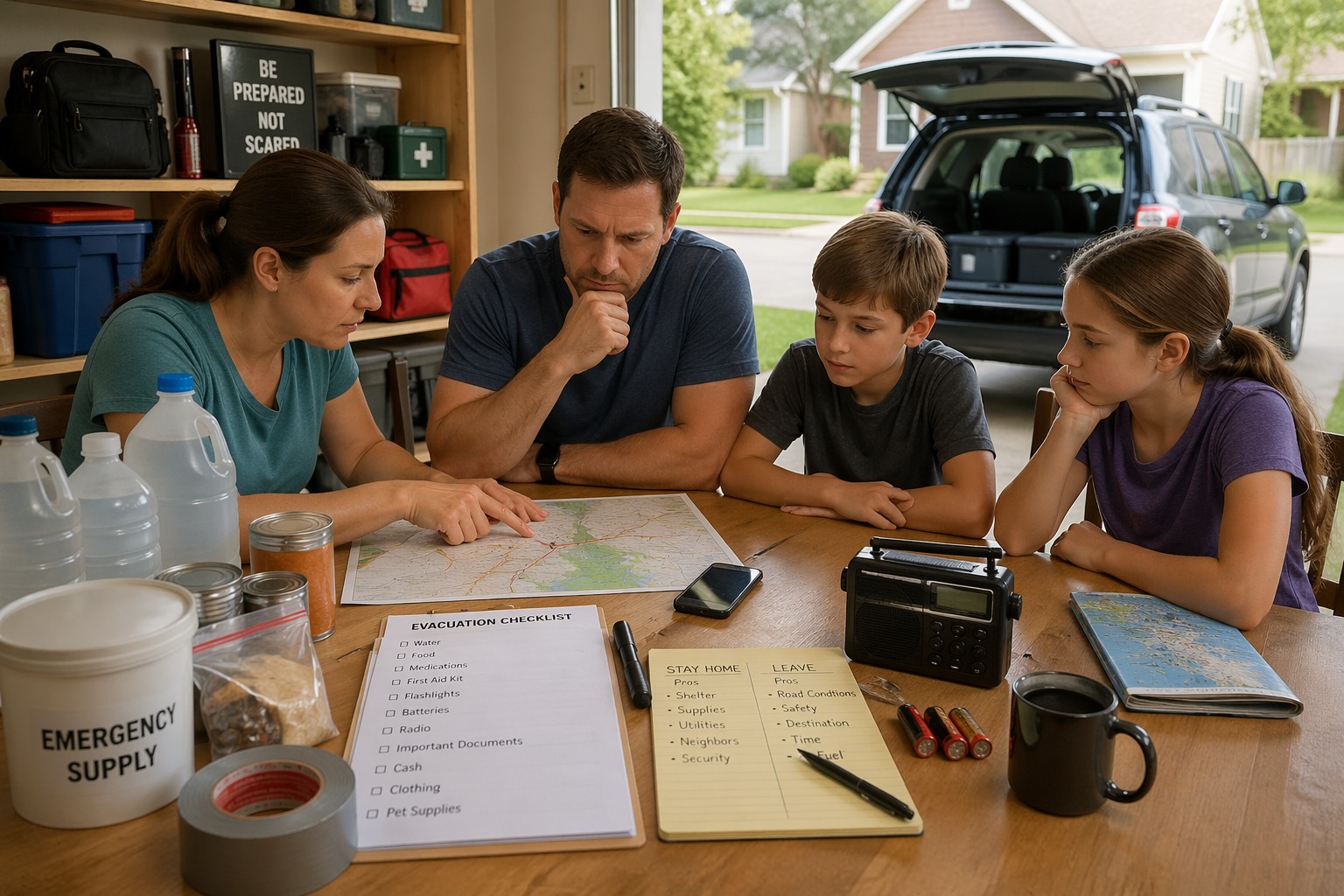
Start With One Question
Before deciding whether to stay or leave, households should ask one question: Can this home safely continue functioning if conditions get worse for the next 72 hours? That question is more useful than watching headlines, waiting for official updates, or reacting to neighbors.
If power, water, food, communication, medical needs, and household security can remain stable, staying home may be the safer and smarter option. If those systems are already failing or outside conditions are removing safe options, leaving early may protect the household far better than waiting.
When Staying Home Is the Better Choice
Shelter-in-place is often the strongest option when the home can safely maintain continuity and outside movement creates more risk than protection. Leaving during storms, civil unrest, wildfire traffic, severe winter conditions, or fuel shortages can turn a manageable disruption into a dangerous travel problem.
A prepared home with stable water, backup power, stored food, medical support, communication options, and strong household routines usually provides more control than uncertain conditions outside. Staying home works best when the household can protect stability without depending on immediate outside rescue.
Utilities Are Still Stable Enough
Even if power is limited, staying home remains practical when water access, refrigeration protection, heating or cooling safety, and sanitation can still be maintained. Households do not need perfect comfort—they need stable function.
The correct question is whether critical systems can continue safely for the next several days. If backup power protects the essentials, water continuity exists, and household routines remain controlled, staying usually creates less risk than leaving.
A common mistake is leaving because comfort is reduced instead of because safety is failing.
Travel Creates More Risk Than Shelter
Road congestion, severe weather, wildfire traffic, fuel shortages, blocked routes, and uncertain destinations can make evacuation far more dangerous than remaining home. Leaving without a clear destination often creates a second emergency instead of solving the first one.
Prepared households compare travel risk against home stability. If roads are unsafe, fuel access is weak, or destination support is uncertain, sheltering in place may be the safer decision.
A common mistake is assuming movement automatically creates safety.
The Home Still Provides Control
Home provides known routines, known supplies, known security, and stronger decision-making control. Medical needs, pets, stored food, communication tools, and neighborhood awareness are often easier to manage at home than during rushed evacuation.
Preparedness is strongest when decisions come from stability. If the household can still control conditions safely, staying home usually preserves more options than abandoning that control too early.
A common mistake is confusing urgency with necessity.
When Leaving Early Is the Smarter Choice
Some households fail because they stay too long. Waiting for certainty during wildfire threats, flooding, severe storms, civil unrest, chemical hazards, or medical dependency failures can remove safe exit options and force dangerous last-minute decisions.
Leaving early is strongest when the home can no longer protect stability or when outside conditions will soon make safe travel impossible. Prepared households do not wait for full collapse—they leave when clear decision triggers show that staying is becoming the greater risk.
The Home Can No Longer Maintain Safety
Leaving becomes the smarter choice when the home can no longer safely support water access, temperature control, medical needs, sanitation, communication, or basic security. A house does not become safer simply because it is familiar. If critical systems are failing and cannot be stabilized, staying may only delay a necessary exit.
The correct question is whether the home can still protect the people inside it. If that answer is becoming uncertain, the decision window is already narrowing.
A common mistake is staying because leaving feels disruptive, even after the house has stopped being reliably safe.
Safe Travel Options Still Exist
Leaving early works best when roads are still open, fuel is still available, visibility is good, and the destination is known and prepared to receive the household. Evacuation is strongest before traffic pressure, weather deterioration, or infrastructure failure removes good options.
Prepared households leave while they still have control over timing, route choice, and destination support. Waiting until everyone else is trying to leave often creates the most dangerous version of evacuation.
A common mistake is confusing “not yet critical” with “safe to wait.”
The Risk Curve Is Clearly Rising
When wildfire movement, flood potential, civil unrest, hazardous air, severe weather, or medical instability is clearly worsening, early departure usually protects more options than late reaction. The goal is not to leave from panic, but to leave before risk accelerates beyond the household’s ability to respond safely.
Prepared households watch for trend direction, not just current conditions. A common mistake is waiting for obvious collapse instead of acting when the risk curve clearly shows that safe delay is ending.
Decide Before You Have To
The best stay-or-leave decision is usually made before the crisis reaches its peak. Waiting for certainty often removes the safest options and forces decisions under pressure. Prepared households decide their thresholds early, communicate those triggers clearly, and act before panic replaces planning.
Know what would make you leave. Know what conditions allow you to stay. When those decisions are made ahead of time, the household responds from structure instead of emotion—and that is where real preparedness becomes strongest.
Return to Household Preparedness Systems