72-Hour Household Outage Response Plan
The first 72 hours of a major outage often determine whether a household stays stable or falls into reactive decision-making. Power failures, severe weather, infrastructure disruptions, and utility breakdowns can quickly affect water access, food storage, communication, and home security.
A structured response plan helps households stay calm, protect critical systems, and prioritize the actions that matter most. Preparedness during the first three days is not about having everything—it is about protecting continuity and avoiding preventable failures.
A household outage response plan should focus first on stabilization, not perfection. The goal is to protect the systems that keep the home functioning: power, water, food access, communication, and security. Clear priorities prevent wasted time, unnecessary purchases, and avoidable mistakes during high-stress situations.
The first 72 hours are where preparation matters most. Households that understand what to check first and what can wait make better decisions, preserve resources, and reduce disruption for everyone in the home.
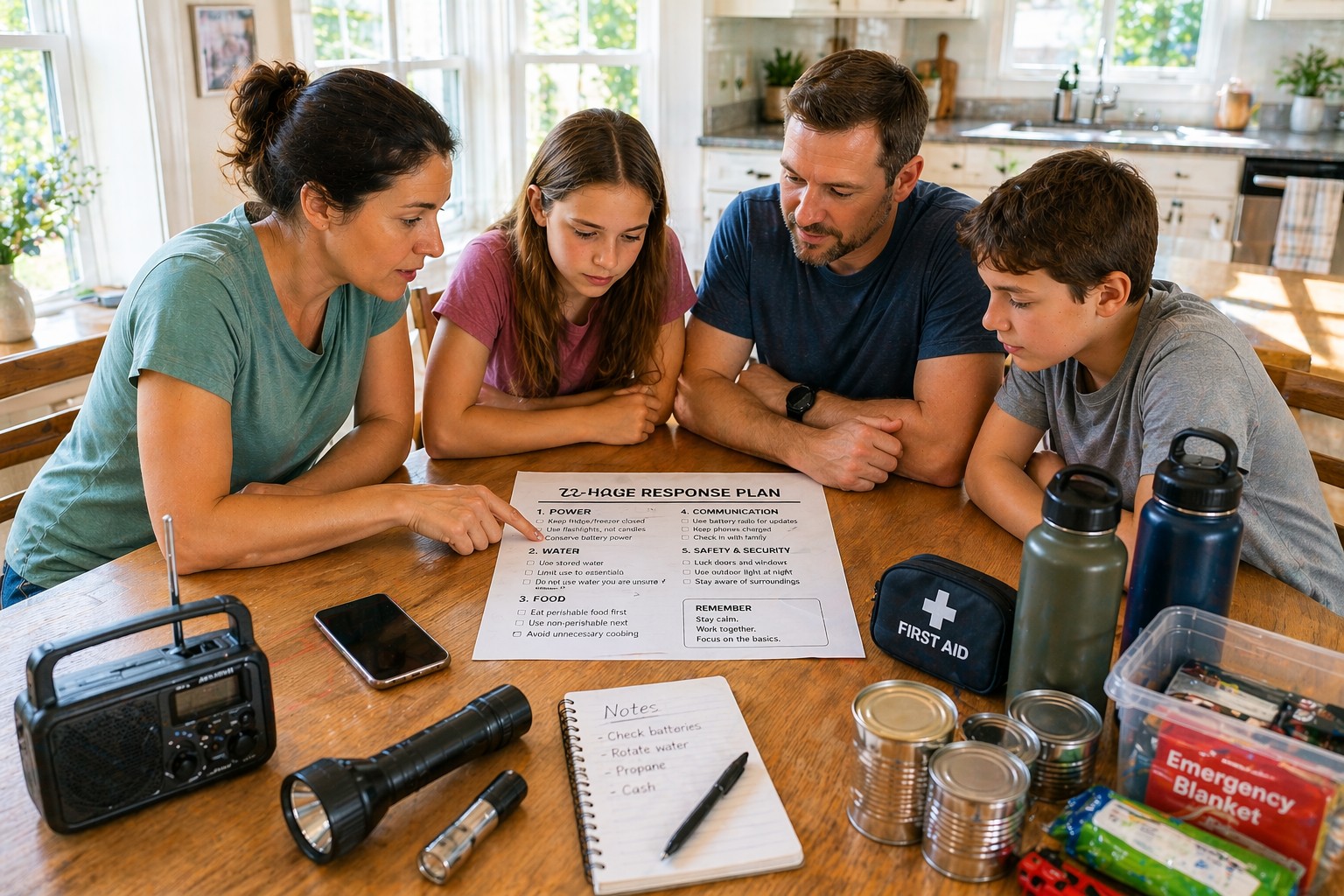
The First 2 Hours Matter Most
The first two hours of a major outage are when households either stabilize quickly or begin making rushed decisions that create larger problems. Early actions should focus on confirming what is failing, protecting critical systems, and preventing avoidable losses before the disruption becomes more complicated.
This is the time to verify refrigeration, preserve water access, charge critical devices, monitor conditions, and establish a calm household routine. The goal is not to solve everything immediately, but to reduce risk and buy time for better decisions.
Immediate Household Checks
Start by checking the systems that fail fastest and create the most household disruption if ignored. Confirm refrigeration status, preserve freezer temperature, charge essential devices, protect stored water, and verify access to flashlights, radios, medications, and backup lighting.
Households with medical devices, infants, elderly family members, or extreme weather exposure should prioritize those risks immediately. Early stability matters more than convenience. Small preventable failures often become the biggest problems later.
Immediate priorities:
- Confirm refrigeration and freezer stability
- Protect drinking water and filtration access
- Charge phones, radios, and essential devices
- Verify medication access and medical needs
- Secure backup lighting and safe nighttime access
- Check weather conditions and utility restoration updates
Stabilize the First 72 Hours
The first goal during a household outage is stabilization. Before solving long-term problems, households need to protect the systems that fail fastest: refrigeration, water access, communication, lighting, and basic home security.
This is not the time for large purchases or rushed decisions. The first 72 hours should focus on preserving resources, reducing unnecessary risk, and keeping the household calm and functional while the situation becomes clearer.
Priority Order for Household Response
Most households lose time because they respond emotionally instead of systematically. A simple priority order prevents wasted effort and helps protect the systems that matter most first.
The correct sequence is usually:
- Power stability
- Water access
- Food preservation and cooking
- Communication and situational awareness
- Security and household routines
This order may shift depending on the disruption, but system protection should always come before convenience.
Day 1 vs Day 2 vs Day 3 Decisions
Not every decision should happen immediately. The first day should focus on stabilization, the second day on preservation and resource management, and the third day on shifting from short-term response to longer-term continuity planning.
Households that treat every outage like a short inconvenience often make expensive mistakes. By Day 3, the goal should shift from “waiting for normal” to protecting stability if disruption continues.
Day 1 — Stabilize
Focus on protecting the systems that fail fastest: refrigeration, water access, lighting, communication, and medical needs. Confirm what is working, what is vulnerable, and what must be protected first.
Avoid unnecessary travel, panic buying, and fuel waste. Day 1 is about preserving options, not solving every long-term problem immediately.
Day 2 — Preserve and Adjust
By the second day, households should begin protecting supplies and adjusting routines. Shift toward shelf-stable food planning, controlled fuel use, reduced power consumption, and stronger communication routines.
This is the time to reduce waste, protect resources, and assume restoration may take longer than originally expected.
Day 3 — Plan for Continuity
By Day 3, households should stop planning for a short inconvenience and start preparing for a longer disruption. Reassess water reserves, backup power runtime, food continuity, household security, and outside support options.
Preparedness becomes much stronger when households shift early from temporary thinking to continuity planning.
Common Mistakes That Make Outages Worse
Many households make outages harder by reacting emotionally instead of systematically. Small mistakes made early—especially with fuel, refrigeration, water, and communication—often create larger problems than the disruption itself.
Preparedness works best when households protect core systems first, preserve flexibility, and avoid decisions driven by panic or false assumptions.
Common mistakes to avoid:
- Assuming utilities will return quickly
- Wasting generator fuel on nonessential loads
- Opening refrigerators and freezers too often
- Delaying water conservation until reserves are already low
- Ignoring backup charging and communication planning
- Treating the outage like a temporary inconvenience for too long
When the Outage Is More Than an Inconvenience
Not every outage is a simple inconvenience. Some disruptions create immediate household risk because of heat, freezing temperatures, medical needs, young children, elderly family members, or limited mobility. These situations change priorities quickly.
Preparedness should always account for the people inside the home first. A household with refrigerated medication, infant formula needs, mobility challenges, or extreme weather exposure must respond differently than a short routine outage.
Higher-risk situations include:
- Refrigerated medications or medical equipment
- Extreme summer heat or winter freezing conditions
- Infants, young children, or elderly family members
- Limited mobility or transportation restrictions
- Oxygen equipment or health-related power dependency
- Households already low on stored water or food reserves
When to Shift From Short-Term Response to Long-Term Planning
Households often lose stability because they continue treating an outage like a short inconvenience long after conditions have changed. The shift to longer-term planning should happen as soon as restoration becomes uncertain, resource use becomes harder to sustain, or critical household systems begin losing resilience.
The goal is to recognize the transition early. Waiting too long to adjust fuel use, water conservation, food planning, and communication routines creates preventable pressure on every other system in the home.
Common signs it is time to shift:
- Utility restoration timelines remain unclear or repeatedly change
- Generator fuel use becomes difficult to sustain
- Stored water reserves are dropping faster than expected
- Refrigerated food preservation is no longer realistic
- Severe weather conditions increase household risk
- Outside support, deliveries, or normal supply access become unreliable
- Household routines must change to preserve stability instead of convenience
Example: How a 72-Hour Outage Escalates
Most outages do not feel serious at first. Households often assume power, water, and normal routines will return quickly. The problem begins when temporary thinking continues after conditions have changed.
A simple example helps show how quickly a normal outage can become a household continuity problem if priorities are not adjusted early.
First 6 Hours — Confirm and Protect
Check refrigeration, freezer status, stored water access, backup lighting, phone charging, medications, and local outage updates. The first goal is preventing immediate losses and confirming whether this is a short disruption or something larger.
Day 1 — Stabilize the Household
Protect critical power use, preserve food, reduce unnecessary travel, and establish clear household routines. Avoid panic buying, fuel waste, and decisions based on assumptions instead of actual conditions.
Day 2 — Preserve Resources
Shift toward shelf-stable food planning, controlled water use, stronger communication discipline, and deliberate fuel management. By now, households should assume restoration may take longer than expected.
Day 3 — Plan for Continuity
Reassess power runtime, water reserves, food continuity, security routines, and outside support options. This is the point where households must stop planning for inconvenience and start planning for sustained stability.
Power First
Protect refrigeration, lighting, device charging, and any medical equipment first. Confirm what must stay powered, reduce unnecessary electrical use, and preserve fuel or battery capacity for critical systems only.
Avoid running backup power without a clear load plan. The goal is stability, not convenience.
If refrigeration cannot be maintained beyond several hours, households should immediately shift from convenience thinking to food preservation planning. Backup power should be reserved for the systems that prevent the fastest losses, not for general household comfort.
If backup power is unavailable or fuel use becomes unsustainable, households should stop planning around normal appliance use and shift immediately to food preservation, limited lighting, and essential-device-only power management
Learn more in Emergency Power Systems for Home Preparedness
Water Access
Confirm drinking water availability immediately. Protect stored water, identify short-term usage limits, and make sure filtration or backup treatment options are ready if stored reserves begin to drop.
Water problems escalate faster than most households expect. Treat water security as a first-priority system.
If stored drinking water drops below a reliable multi-day reserve, households should immediately move from normal usage habits to controlled conservation. Waiting too long to reduce water use creates faster failure than most families expect.
If reliable refill options are uncertain, households should stop treating stored water as temporary backup and begin managing it as a controlled continuity resource. Conservation should begin before reserves feel critically low.
Learn more in Water Systems
Food Stability
Protect refrigeration first, then shift quickly to shelf-stable food planning if outages continue. Reduce waste, preserve cold storage, and simplify cooking requirements early.
Food continuity depends more on planning than inventory. Households should protect usable calories before they lose them.
If refrigeration loss becomes likely, households should stop planning around fresh food and shift immediately to shelf-stable meal planning. Protecting usable calories early prevents unnecessary waste and reduces stress as outages continue.
If refrigerated food loss becomes unavoidable, households should stop trying to preserve normal meal routines and shift immediately to shelf-stable food planning, simplified cooking, and controlled calorie management for longer continuity.
Learn more in Food Systems for Long-Term Infrastructure Disruption
Communication Awareness
Maintain access to reliable updates and preserve local communication options. Weather radios, backup charging, and written contact plans become far more important once normal systems become unreliable.
Situational awareness prevents poor decisions and unnecessary risk.
If cellular service becomes unreliable or charging access becomes limited, households should immediately shift to backup communication routines. Written contact information, weather radios, and local coordination become far more important once normal communication habits fail.
If normal communication becomes unreliable, households should stop depending on convenience-based contact and move immediately to written plans, scheduled check-ins, backup charging discipline, and local coordination that does not rely on constant connectivity.
Learn more in Communication Systems for Emergency Preparedness
Security Routine
Secure access points, protect lighting, and maintain normal household routines. Calm, predictable routines reduce stress and improve decision-making far more than reactive “security mode.”
Prepared households protect stability first and escalation second.
If outages extend into multiple nights, households should shift from normal convenience routines to deliberate access control, lighting management, and predictable household habits. Security problems often begin with disorder and uncertainty, not immediate outside threats.
If outages extend beyond normal routines, households should stop relying on casual habits and move to deliberate access control, predictable lighting routines, and clear household expectations that reduce confusion and prevent small problems from escalating.
Learn more in Home Security Systems for Emergency Preparedness
Return to Household Preparedness Systems