The First 24 Hours After a Home Utility Failure
The first 24 hours after a utility failure often determine whether a household stays stable or begins reacting under pressure. Power loss, water interruption, communication breakdowns, and service disruptions create fast-moving problems that become harder and more expensive to solve if early decisions are delayed.
Strong preparedness during the first day is not about doing everything at once. It is about protecting the systems that fail fastest, preventing avoidable losses, and creating enough stability for the household to respond calmly and deliberately.
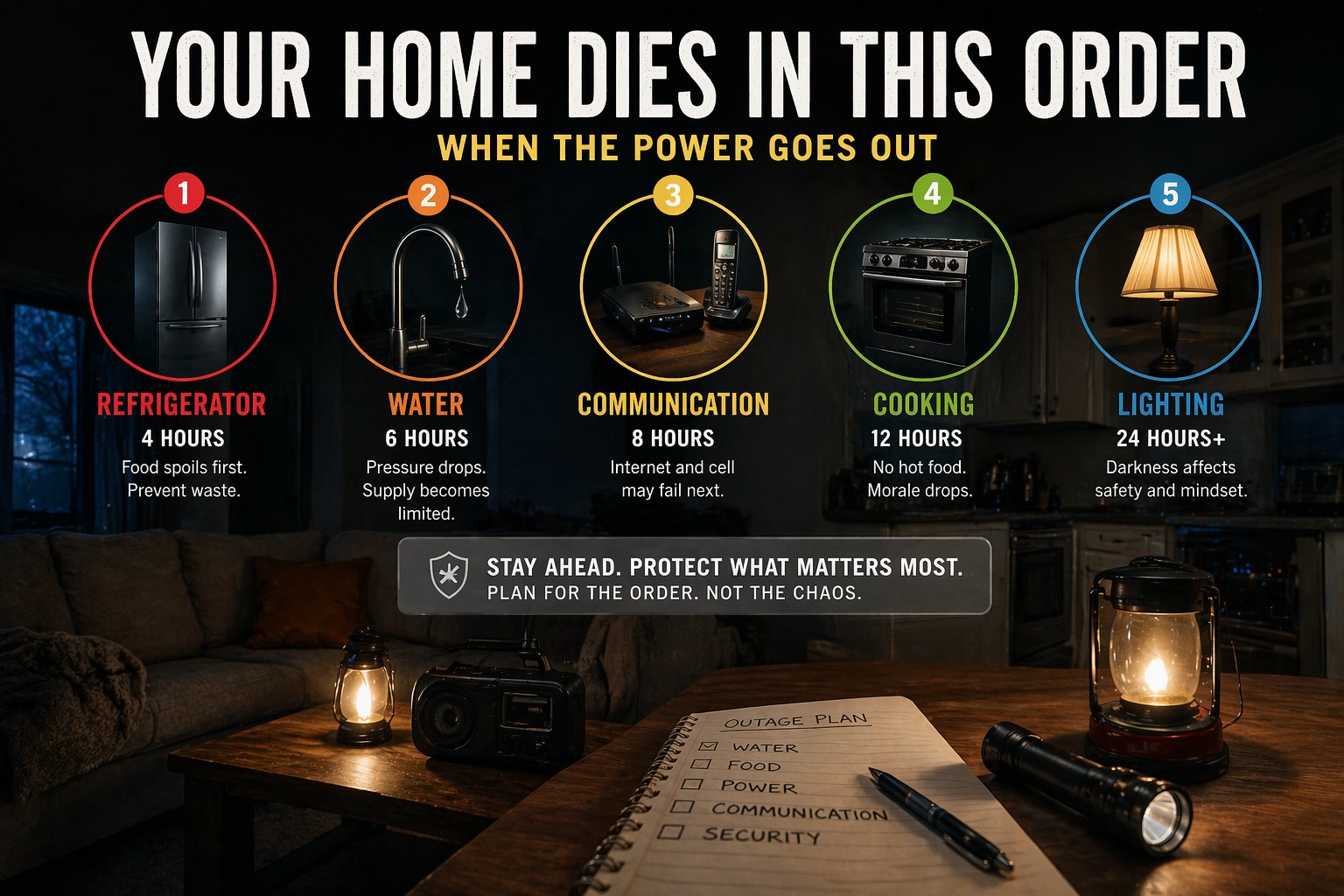
The first day after a utility failure is where most preventable household mistakes happen. People often focus on inconvenience instead of consequence—trying to restore comfort before protecting refrigeration, water access, backup power, medications, and communication plans. Small delays during the first few hours can create much larger failures by the end of the day.
A structured response protects stability first. Households that know what to check immediately, what can wait, and when priorities must shift preserve resources longer and avoid turning a short disruption into a much larger continuity problem.
The First Hour Sets the Direction
The first hour after a utility failure is where households either stabilize quickly or begin creating larger problems. Early decisions determine whether refrigeration is protected, water access remains secure, devices stay charged, medications remain safe, and communication stays functional.
This is not the time for panic buying, unnecessary travel, or trying to restore normal comfort. The goal is to confirm what is failing, protect the systems that create the fastest instability, and prevent avoidable losses before the situation becomes harder to manage.
Immediate Household Checks
Start by checking the systems that fail fastest and create the most household disruption if ignored. Confirm refrigeration and freezer status, protect stored water, charge essential devices, verify medications, and secure backup lighting before focusing on comfort or convenience.
Households with infants, elderly family members, medical devices, or extreme weather exposure should prioritize those risks immediately. Small preventable failures in the first hour often become the most expensive problems by the end of the day.
A common mistake is assuming the outage will be short and delaying action. Strong preparedness treats the first hour as decision time, not waiting time.
The First 6 Hours Matter Most
The first six hours determine whether the household stays in control or starts reacting to preventable losses. Refrigeration begins warming, freezer protection becomes time-sensitive, backup charging opportunities shrink, and water planning becomes more important if restoration timelines remain unclear.
This is the decision window where households should stop assuming normal routines will return quickly. Fuel use, food preservation, communication plans, and household expectations should begin shifting from convenience to continuity.
Refrigeration and Freezer Protection
If refrigeration cannot be maintained, households should immediately shift from normal meal planning to food preservation decisions. Limit refrigerator opening, protect freezer temperature, and identify which foods must be used first before loss becomes unavoidable.
If power restoration remains unclear after several hours, households should stop planning around fresh food and begin transitioning to shelf-stable meals and controlled food use. Waiting too long creates unnecessary waste and often forces rushed decisions later.
A common mistake is treating the refrigerator like normal while waiting for power to return. Prepared households protect usable calories early instead of reacting after food loss has already happened.
Fuel and Backup Power Discipline
Backup power should protect critical systems first: refrigeration, medical equipment, communication devices, and limited lighting. Running generators for comfort loads too early often creates larger failures when fuel becomes unavailable later.
If fuel replacement is uncertain, households should immediately stop planning around normal appliance use and shift to essential-load-only power management. Convenience loads should be removed before fuel becomes the emergency.
The goal is continuity, not normal comfort. Strong households manage backup power like a limited resource, not a temporary replacement for normal utility service.
Water Confirmation
Confirm drinking water availability immediately, not after stored reserves begin dropping. If refill options are uncertain, households should move to controlled conservation early and protect filtration options before water becomes the crisis.
If reliable refill access cannot be confirmed, households should stop normal water habits and begin treating stored water as a controlled continuity resource. Drinking, cooking, sanitation, and hygiene all compete for the same limited supply.
A common mistake is assuming water is fine simply because taps still work. Prepared households plan for continuity before normal supply becomes unreliable.
Before the First Day Ends
Before the first 24 hours end, households should stop treating the outage like a short inconvenience and start evaluating continuity. Fuel use, food preservation, water reserves, communication reliability, and household routines should all be reviewed with the assumption that restoration may take longer than expected.
This is where strong preparedness separates from reactive behavior. Waiting until Day 2 to change strategy often means preventable losses have already happened. The first day should end with clearer decisions, not more uncertainty.
Communication Reliability
If normal communication becomes unreliable, households should stop depending on convenience-based contact and move to written plans, scheduled check-ins, backup charging discipline, and local coordination that does not rely on constant connectivity.
Weather radios, printed contacts, neighborhood awareness, and simple household communication routines become far more valuable once normal networks become unstable. Waiting until communication fails completely creates unnecessary confusion and poor decisions.
A common mistake is assuming phones alone are the plan. Prepared households protect communication before silence becomes the problem.
Security and Household Routine
If outages extend into multiple nights, households should shift from normal casual routines to deliberate access control, exterior lighting awareness, and predictable household expectations. Security problems often begin with disorder and uncertainty, not immediate outside threats.
Clear routines reduce stress, improve decision-making, and prevent small problems from escalating. Strong preparedness focuses on visibility, stability, and controlled household habits before equipment or fear-driven responses.
A common mistake is treating security as panic instead of management. Prepared households protect routine first.
Household Decision Point
By the end of the first day, every household should answer one question: Is this still temporary, or are we now planning for continuity? That decision changes fuel use, food strategy, water conservation, and outside support planning.
If restoration timelines remain unclear, resources are dropping faster than expected, or normal routines can no longer be maintained safely, the response should shift immediately. Strong preparedness happens when households recognize the transition early instead of reacting too late.
A common mistake is waiting for certainty before changing strategy. Prepared households move when conditions change, not when inconvenience becomes crisis.
Common Failure Points in the First 24 Hours
Most household failures during the first day do not happen because the outage itself is extreme. They happen because people delay action, protect the wrong systems first, or continue operating like normal long after conditions have changed.
Preparedness works best when households respond to consequence instead of inconvenience. Small mistakes made early—especially with refrigeration, water, fuel, and communication—often create the largest problems later.
Waiting Too Long to Change Behavior
Many households lose stability because they continue using fuel, water, refrigeration, and communication systems as if the outage will end soon. That delay often feels harmless at first, but it creates preventable losses once restoration takes longer than expected.
The correct response is to change behavior before resources feel critically low. Strong preparedness begins conservation, controlled fuel use, and simplified routines early so the household stays ahead of the disruption instead of reacting after losses have already occurred.
A common mistake is waiting for certainty before changing strategy. Prepared households adjust when conditions shift, not when convenience is already gone.
Protecting Comfort Instead of Stability
People often spend the first day trying to restore normal comfort—running generators for televisions, using fuel for convenience loads, or focusing on internet access before water and food continuity are secured. Comfort feels urgent, but it rarely creates true household failure.
The correct response is to protect the systems that fail fastest: refrigeration, water access, medications, communication, and safe household routines. Strong preparedness separates inconvenience from consequence and protects stability first.
A common mistake is solving visible frustration before hidden system failure. Prepared households manage priorities by consequence, not annoyance.
Assuming Utility Restoration Will Be Fast
Many households delay conservation because they assume power, water, or normal services will return quickly. That assumption often causes the biggest failures—fuel gets wasted, refrigerated food is lost, and water reserves drop before a real plan exists.
The correct response is to plan for uncertainty, not optimistic timelines. If restoration estimates are unclear or repeatedly change, households should immediately shift to continuity thinking and manage resources as if the disruption may last longer than expected.
A common mistake is treating official restoration estimates like guarantees. Prepared households protect stability first and let restoration become a bonus, not the plan.
Return to Household Preparedness Systems