The Foundation Framework: A Structured Household Preparedness System
Preparing for long-term disruption can feel overwhelming. Many people respond by purchasing emergency supplies without a clear plan, often leaving critical gaps that only become apparent during an actual emergency.
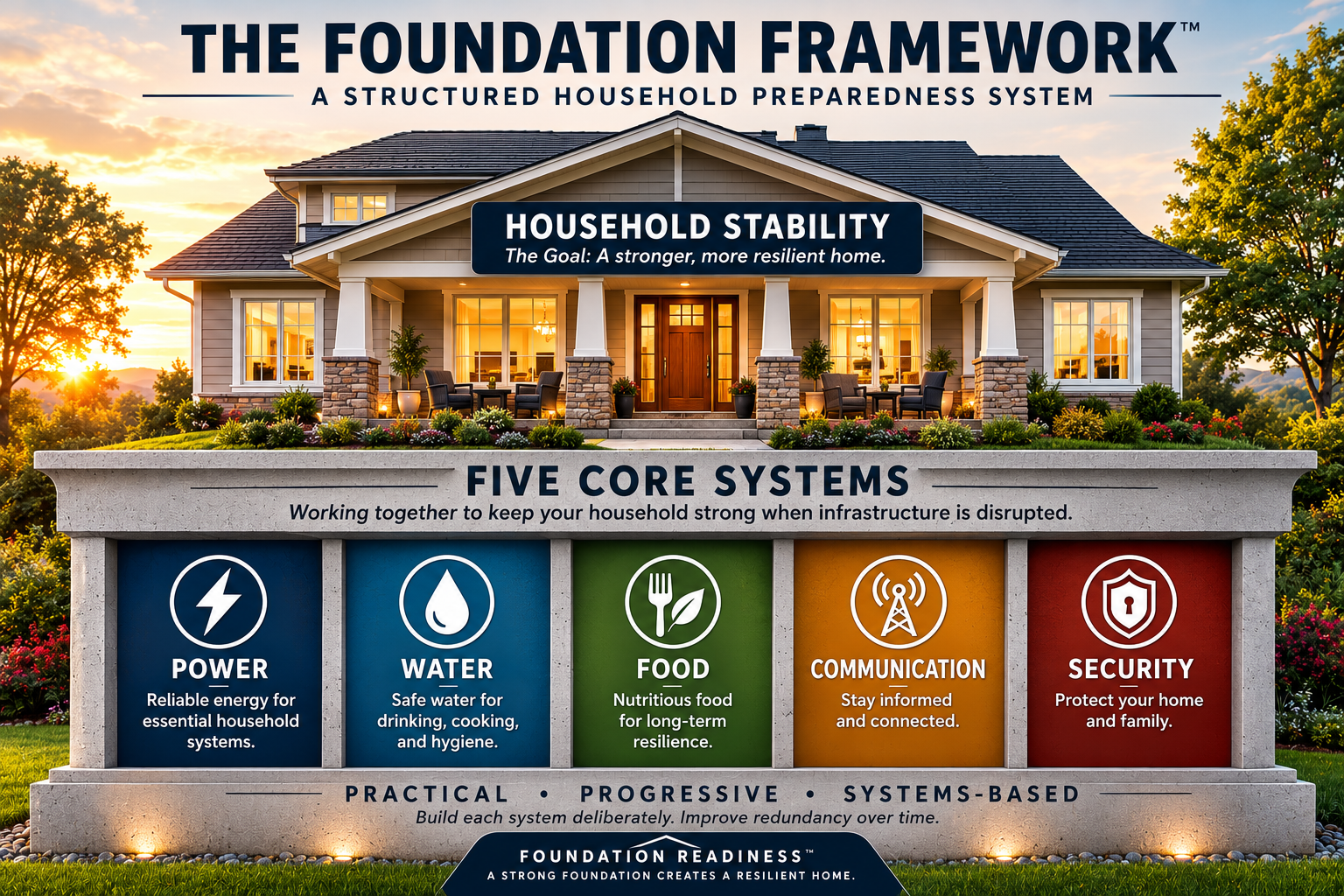
The Foundation Framework provides a structured approach to household preparedness by focusing on the five core systems every home depends on: Power, Water, Food, Communication, and Security. Rather than treating preparedness as a collection of individual products, the Framework views it as a series of interconnected systems that should be strengthened deliberately over time.
By building each system in a logical sequence, households can reduce vulnerabilities, improve resilience, and create a practical preparedness plan that grows as their needs, budget, and experience evolve.
Why Most Preparedness Plans Fail
Most households prepare by purchasing individual emergency supplies as needs arise or as new products catch their attention. While these purchases may be useful, they often occur without an overall plan, resulting in important vulnerabilities being overlooked.
For example, a household may own a generator but have no long-term fuel strategy. They may store food but have insufficient water. They may install security cameras but have no backup power to keep them operating during an extended outage.
The Foundation Framework approaches preparedness differently. Instead of focusing on isolated equipment or individual emergencies, it strengthens the essential household systems that support everyday life. By addressing these systems in a logical sequence, preparedness becomes more organized, balanced, and sustainable.
The Foundation Framework
The Foundation Framework organizes household preparedness around the five essential systems that support everyday life: Power, Water, Food, Communication, and Security. Every household relies on these systems, whether during normal conditions or extended disruption.
The systems are interconnected. Weakness in one often affects the others. For example, a prolonged power outage can disrupt refrigeration, water access, communications, and many security measures. Strengthening each system individually—and understanding how they work together—creates a more resilient household overall.
The Framework is designed to be implemented progressively. Begin by strengthening the system that presents the greatest vulnerability for your household. Once a reliable foundation has been established, continue improving each system over time while adding appropriate redundancy where it provides meaningful value.
Preparedness is not about owning the most equipment. It is about building dependable household systems that continue functioning when normal infrastructure does not.
The Five Core Systems of Household Stability
Each of the five core systems plays a critical role in household preparedness. While every system can be improved independently, they are most effective when developed together as an integrated foundation. Explore each system below to learn how they contribute to long-term household stability.
POWER
Backup power isn’t just about comfort — it’s about maintaining critical household functions. The Power System covers planning, sizing, redundancy, and practical options for extended outages.
WATER
Reliable water access is critical during infrastructure disruption. The Water System focuses on storage, purification, redundancy, and long-term supply planning.
FOOD
Food resilience requires more than stored goods. The Food System addresses planning, storage strategy, rotation, caloric needs, and long-term supply continuity.
COMMUNICATION
When networks fail, coordination becomes difficult. The Communication System focuses on redundancy, off-grid communication options, and maintaining reliable contact during extended disruption.
SECURITY
Stability depends on layered protection. The Security System addresses physical safeguards, visibility, deterrence, and practical measures for protecting people and property during prolonged instability.
How to Build Your Foundation
The Foundation Framework is designed to be implemented progressively rather than all at once. Most households cannot strengthen every system immediately, and they do not need to. The goal is steady, deliberate improvement over time.
Begin by identifying the system that represents the greatest vulnerability in your household. For one family, that may be emergency water storage. For another, it may be backup power or communication during extended outages. Strengthen that system first, then continue building the others in a logical sequence.
As each system becomes more reliable, look for opportunities to improve redundancy where it provides meaningful value. A resilient household is not created by purchasing the most equipment—it is created by building dependable systems that continue functioning when normal infrastructure cannot.
The Foundation Framework provides a roadmap for that process, allowing preparedness to grow in a practical, organized, and sustainable way.
The Stability Principle
Household resilience is not built through isolated purchases or reactive decisions. It is built through deliberate system design. The Stability Principle recognizes that infrastructure disruption affects multiple household systems at the same time, making a balanced, systems-based approach far more effective than preparing for individual events in isolation.
By strengthening Power, Water, Food, Communication, and Security in a deliberate sequence, households reduce vulnerabilities, improve long-term resilience, and gain confidence that essential needs can continue to be met when normal infrastructure is disrupted.
The Foundation Framework is not a checklist to complete—it is a practical method for building a stronger, more resilient household over time. Begin with your greatest vulnerability, strengthen one system at a time, and continue building your foundation as your preparedness evolves.