Water Systems for Long-Term Disruption Planning
Water is the fastest household system to fail during extended disruption. This page provides a structured approach to storing, producing, filtering, and safely using water when municipal supply is unreliable or unavailable. The goal is simple: maintain safe daily water access for drinking, sanitation, and basic cooking—without improvisation
If your Household Readiness Assessment identified Water Readiness as a priority improvement area, start here.
Most households do not need more water gear—they need a simple, reliable water plan. Begin by determining how much water your household actually needs, then build a stored water reserve and establish a backup treatment method.
Follow the guides below in order. Each step builds on the previous one and helps create a more resilient household water system.
Reliable access to clean water is one of the most critical parts of household preparedness. Water systems must support immediate needs, long-term continuity, and safe usage during disruptions when normal infrastructure becomes unreliable or unavailable.
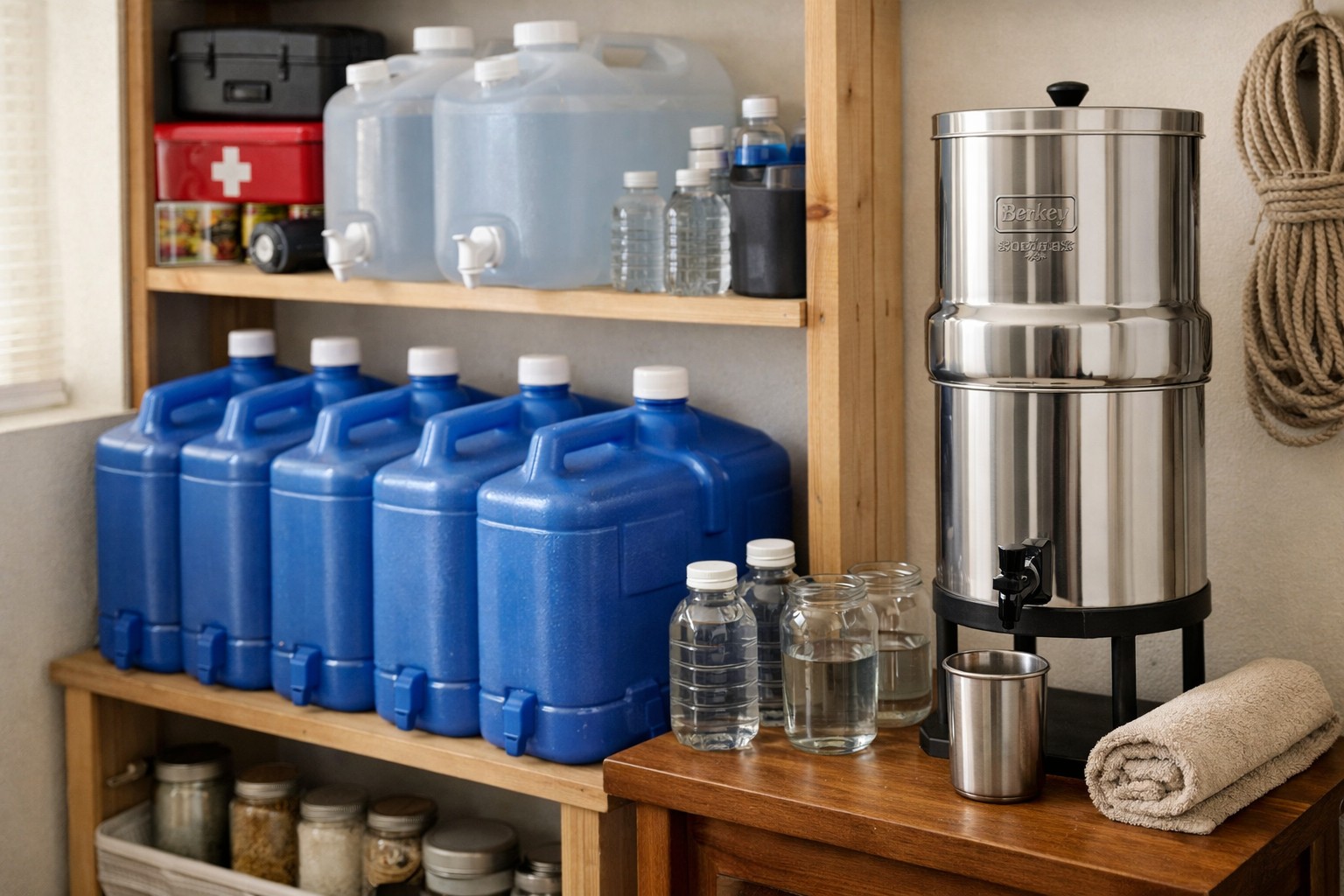
Primary Water Solution Paths
Most households will combine more than one water strategy. Each solution path has strengths, limitations, and ideal use cases depending on duration, storage capacity, and local water access. The objective is redundancy—safe water must remain available even if one layer fails.
Stored Water (Immediate Coverage)
Stored water provides the fastest and most reliable short-term coverage during disruption. It requires no power, no moving parts, and no active treatment if rotated properly. Every household should maintain a baseline reserve before relying on filtration or sourcing strategies.
For practical guidance on building dependable reserves, see Water Storage Planning to create a safe and reliable long-term household water supply.
Common stored-water components include:
• Water bricks or stackable containers for indoor storage
• Food-grade barrels for larger reserve capacity
• Pre-filled bottled water for rapid deployment
• Simple rotation schedule to maintain freshness
• Safe storage location (cool, dark, protected)
For practical container selection and rotation planning, see the Water Storage Containers implementation guide.
Filtration & Purification (Making Water Safe)
Filtration removes sediment and many biological contaminants, while purification methods help neutralize pathogens. This layer allows households to safely use collected or uncertain water sources when stored reserves run low. A structured plan uses multiple methods, not just one, because failure modes differ. For a deeper look at reliable off-grid filtration, see Gravity-Fed Water Filters for Household Disruption Planning to understand how gravity systems support long-term clean water access
Common filtration and purification components include:
• Gravity-fed water filters for daily household use
• Portable backpacking-style filters for mobility
• Chemical purification tablets as backup
• Boiling as a fail-safe treatment method
• Redundant filter elements stored in reserve
For household-scale daily filtration without power, see the Gravity-Fed Water Filters implementation guide.
For mobile filtration and uncertain source collection, see the Portable Backpack Water Filters implementation guide.
Sourcing & Collection (Longer-Term Continuity)
When disruption extends beyond stored reserves, households must identify reliable water sources and safe collection methods. This layer focuses on continuity—where water will come from and how it will be transported, stored, and treated without increasing contamination risk.
Common sourcing and collection components include:
• Rainwater collection (where legal and appropriate)
• On-property sources (wells, springs, storage tanks)
• Transport containers for safe hauling
• Pre-filters for sediment-heavy sources
• A clear “treatment sequence” (collect → pre-filter → filter → purify → store)
Minimum Household Water Baseline
As a starting point, households should plan for at least one gallon of water per person per day for drinking and minimal sanitation. This baseline supports short-term disruption but is not sufficient for extended outages involving heat, medical needs, or high-activity environments. Long-term planning requires layered storage, treatment capability, and source identification.
This water plan is one layer of the Foundation Framework. If you haven’t reviewed the framework sequence yet, start there before building deeper redundancy.
Water preparedness is closely connected to other household resilience systems. Reliable food storage requires adequate water for cooking and preparation, and many water purification systems depend on backup power during extended outages.
Water Storage Planning
Water storage planning determines how long your household can remain stable during a disruption. A reliable system includes enough stored water for drinking, cooking, sanitation, and basic hygiene—not just short-term emergencies.
Storage planning should account for household size, refill limitations, and realistic disruption timelines. Building dependable reserve capacity reduces pressure on emergency sourcing and improves overall household resilience.
How Much Water to Store
The amount of water a household needs depends on the number of people, expected outage duration, and intended usage. Short-term disruptions require different planning than extended infrastructure failures, making baseline calculations an important starting point.
Rotation and Maintenance
Stored water must remain safe and usable over time. Rotation schedules, proper container selection, and contamination prevention all play an important role in maintaining a dependable reserve system.
Integrating Water Into Your Preparedness System
Water systems support every major part of household preparedness. Food storage depends on clean water for cooking and sanitation, communication systems require reliable household stability, and security planning becomes far more difficult when basic water needs are not met.
A complete preparedness plan connects water systems with Emergency Power Systems for Home Preparedness, Food Systems, Communication Systems for Emergency Preparedness, and Home Security Systems for Emergency Preparedness so that every household function remains stable during extended disruptions.
Return to Household Preparedness Systems