Household Backup Power Load Calculator: Starting Watts & Running Watts
A Household Backup Power Load Calculator helps determine how much power your home actually needs during an outage by accounting for both running watts and the additional starting watts required by appliances with motors or compressors.
To estimate your backup power requirement, first identify the appliances and equipment you need to keep operating. Add the running watts of the loads that may operate at the same time, then account for the largest additional startup demand from equipment such as a refrigerator, well pump, sump pump, furnace blower, or air conditioner.
This calculation provides a practical starting point for sizing a portable generator, inverter generator, or battery backup system without assuming that every appliance in your home must be powered at once.
The goal is not to power everything. It is to identify the critical household loads that must continue operating and determine the power required to support them reliably.
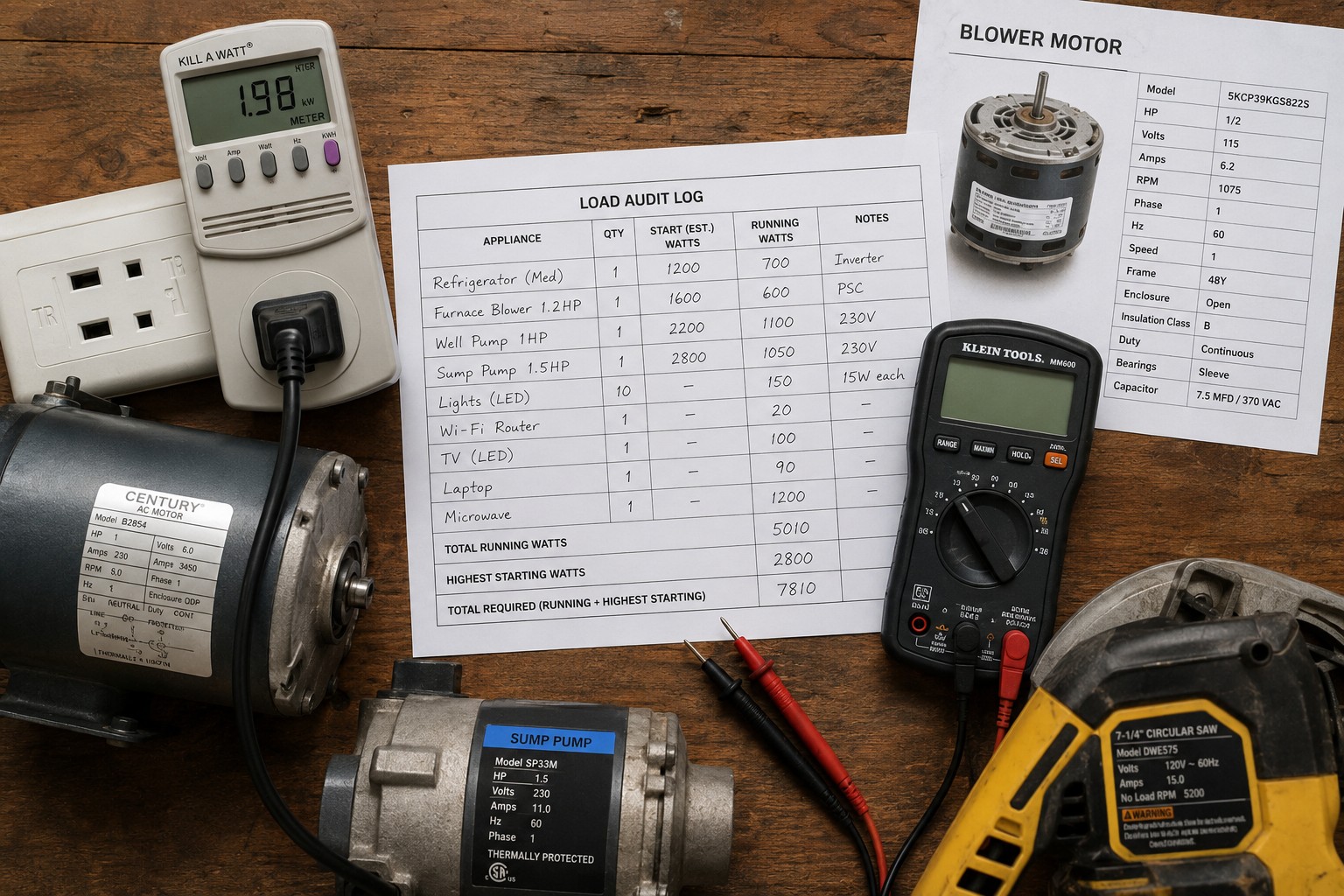
Household Backup Power Load Calculator
Use the calculator below to estimate the power required to operate your household’s essential equipment during an outage. Enter the running watts and starting watts for the appliances and systems you want to keep available.
For the most accurate result, use the wattage information from the equipment manufacturer, owner’s manual, or appliance nameplate whenever possible. Published appliance wattage estimates can be useful for preliminary planning, but actual power requirements vary by model.
Your calculated load is a planning estimate—not automatically the generator or battery size you should purchase. Voltage requirements, surge capability, connection method, operating margin, and runtime must also be considered.
Enter the actual running and starting wattage for the equipment you want available during an outage. Check Include for each load you want included in the calculation.
| Appliance / Equipment | Running Watts | Starting Watts | Include |
|---|---|---|---|
| Refrigerator | |||
| Freezer | |||
| Well Pump | |||
| Sump Pump | |||
| Furnace Blower | |||
| Central A/C or Heat Pump | |||
| Microwave | |||
| Lighting | |||
| Communications / Device Charging | |||
Estimated Backup Power Load
Planning estimate: This calculator assumes the selected loads may run simultaneously and adds the largest additional startup surge. Actual equipment requirements, voltage, generator or inverter ratings, connection method, operating margin, and the possibility of multiple loads starting together must also be considered. Use manufacturer specifications whenever available.
Starting Watts vs. Running Watts
Running watts are the continuous watts an appliance or device requires while operating normally.
Starting watts are the additional watts some motor- or compressor-driven equipment may require for a brief period when it starts.
A refrigerator, freezer, well pump, sump pump, furnace blower, or air conditioner may run at one wattage level but require substantially more power for startup. If your backup system can handle the running load but not the startup surge, the appliance may fail to start or the generator or inverter may overload.
For backup power planning, both numbers matter.
How to Calculate Your Household Backup Power Load
Step 1: List the Loads You Need During an Outage
Start with the equipment that supports essential household functions rather than trying to power everything in the home.
Typical priorities may include refrigeration, a freezer, well or sump pumps, a furnace blower, selected lighting, communication devices, medical equipment, and limited cooking appliances.
The objective is to identify the loads that may need to operate during the same period. This creates a realistic backup power plan and prevents unnecessary oversizing.
Step 2: Find the Actual Running Watts
Running watts represent the power an appliance or piece of equipment requires during normal operation. Whenever possible, use the electrical specifications for your actual equipment rather than relying on a generic appliance wattage chart.
Check the manufacturer’s documentation, owner’s manual, equipment label, or nameplate for power information. Depending on the equipment, the specifications may list watts directly or provide voltage and amperage information that can help determine the electrical load.
Generic wattage estimates are useful for preliminary planning, but the specifications for your actual equipment provide a more reliable basis for backup power sizing.
Step 3: Identify Starting or Surge Watts
Some appliances require a brief burst of additional power when a motor or compressor starts. This startup demand can be significantly higher than the power required once the equipment is running normally.
Refrigerators, freezers, well pumps, sump pumps, furnace blowers, air conditioners, and other motor-driven equipment are common examples. Check the manufacturer’s specifications for starting, surge, or maximum wattage whenever that information is available.
For each load, determine the additional startup surge by subtracting its running watts from its starting watts.
Additional Startup Surge = Starting Watts − Running Watts
For example, equipment rated at 1,000 running watts and 3,000 starting watts has an additional startup surge of 2,000 watts.
This distinction is important because the calculator uses the additional surge—not the entire starting-watt figure—when determining the estimated minimum surge requirement.
Step 4: Add the Simultaneous Running Load
Add the running watts for the equipment you realistically expect to operate at the same time. This becomes your total simultaneous running load.
For example, if a refrigerator, well pump, furnace blower, lighting, and communication equipment may all be operating during the same period, their running wattages should be included in the total.
This does not mean every electrical device in the home must be counted. Backup power planning becomes more practical when high-demand appliances can be used selectively rather than simultaneously.
Total Running Load = Running Watts of All Loads Expected to Operate at the Same Time
Step 5: Add the Largest Startup Requirement
Once the simultaneous running load is known, identify the selected appliance with the largest additional startup surge. Add that surge to the total running load to estimate the power required while that appliance starts.
Estimated Minimum Surge Requirement = Total Simultaneous Running Watts + Largest Additional Startup Surge
For example, if your simultaneous running load is 2,100 watts and the largest additional startup surge is 2,000 watts, the estimated minimum surge requirement is:
2,100 W + 2,000 W = 4,100 W
This method assumes the selected loads may operate simultaneously but that their largest startup surges do not all occur at exactly the same moment. If multiple high-demand motors or compressors may start together, the actual surge requirement can be higher.
This sizing approach is also used in generator guidance from Champion Power Equipment, which recommends totaling the running watts of the equipment being powered and then accounting for the highest additional starting-watt requirement.
That final sentence is important because it prevents us from presenting the calculator’s method as universally applicable under every possible operating condition.
Step 6: Compare the Result With Your Backup Power System
Compare the calculated load with both the continuous output and surge or starting output of the generator, inverter, or battery backup system you are considering.
The backup system must be capable of supporting the expected running load while also providing enough short-term power for equipment startup. Voltage requirements matter as well. Some well pumps, central HVAC equipment, and other large household loads operate at 240 volts, which not every portable generator or battery system can provide.
Avoid treating the calculated minimum as an automatic purchase recommendation. Allowing reasonable unused capacity provides room for variations in actual equipment demand, additional small loads, and operating conditions that may differ from the initial estimate.
The calculator establishes the electrical load you need to support. The next step is matching that requirement to a backup power system with the appropriate continuous output, surge capability, voltage, and connection method.
Worked Example: Refrigerator, Well Pump and Furnace Blower
A worked example shows how running watts and startup surge affect the final backup power calculation. The figures below are illustrative only and are not intended to represent the requirements of every refrigerator, well pump, or furnace blower.
Assume a household wants to operate these three essential loads during an outage:
| Equipment | Running Watts | Starting Watts | Additional Startup Surge |
|---|---|---|---|
| Refrigerator | 500 W | 1,500 W | 1,000 W |
| Well Pump | 1,000 W | 3,000 W | 2,000 W |
| Furnace Blower | 600 W | 1,200 W | 600 W |
The three appliances have a combined simultaneous running load of 2,100 watts. The well pump has the largest additional startup surge at 2,000 watts.
2,100 W running load + 2,000 W startup surge = 4,100 W estimated minimum surge requirement
This does not mean a 4,100-watt generator is automatically the correct choice. The backup system must still be evaluated for continuous output, surge capability, voltage, connection requirements, operating margin, and the possibility that more than one high-demand load could start at nearly the same time.
How Common Household Loads Affect the Calculation
Refrigerators and Freezers
Refrigerators and freezers are common backup power priorities because maintaining refrigeration helps protect stored food during an extended outage. Their compressors also make them important to account for correctly when calculating startup demand.
A refrigerator or freezer does not normally draw its rated running power continuously. The compressor cycles on and off as needed, but each restart may create a brief startup surge that the backup power system must be capable of handling.
Do not assume that a generic refrigerator wattage applies to your appliance. Models vary considerably in size, age, efficiency, compressor design, and electrical demand. Use the manufacturer’s specifications or equipment label whenever possible and enter those values into the Household Backup Power Load Calculator.
Well Pumps
Well pumps can be one of the most demanding essential loads in a household backup power plan. Although a pump may operate intermittently, its electric motor can require substantially more power during startup than while pumping water normally.
Power requirements vary with the pump motor, horsepower, voltage, depth, system design, and specific equipment. Many residential well pumps also operate at 240 volts, so wattage alone does not determine whether a particular generator or battery backup system can operate the pump.
Check the pump motor nameplate, control equipment, owner’s documentation, or manufacturer specifications for the actual electrical requirements. If those specifications are unclear—or the pump is hardwired and its electrical characteristics cannot be readily identified—consult a qualified electrician or pump professional before selecting backup equipment.
For backup power planning, a well pump must be evaluated for both its running load and startup demand, as well as the voltage the backup system must provide.
Furnace Blowers
A gas or propane furnace may use fuel to produce heat, but it still depends on electricity to operate components such as the blower motor, controls, and ignition system. During a winter outage, that electrical requirement can make the furnace an important part of the household backup power calculation.
The blower motor may also require additional power when it starts. Actual running and startup requirements vary by furnace and blower design, so use the equipment nameplate, manufacturer documentation, or measured specifications rather than relying solely on generic wattage estimates.
Remember that supplying sufficient wattage is only part of the problem. A permanently installed furnace must also be connected to backup power using an appropriate and code-compliant method.
Include the furnace blower’s actual running and starting watts in the Household Backup Power Load Calculator when maintaining home heating is part of your outage plan.
Sump Pumps
Sump pumps can become especially important during outages caused by heavy rain or severe storms—the same conditions that may increase the amount of water entering a basement or crawl space.
Like other motor-driven equipment, a sump pump may require considerably more power when its motor starts than while it is running. Pump size, motor design, discharge conditions, and the specific model all affect its electrical demand.
Use the pump’s nameplate or manufacturer specifications to identify its running and starting requirements whenever possible. If the sump pump is a critical load, also consider how frequently it may need to cycle during an extended outage.
Include both the running watts and startup demand when calculating the backup power required to keep a sump pump available.
Central Air Conditioning and Heat Pumps
Central air conditioners and heat pumps can be among the largest electrical loads considered for household backup power. Their compressors and motors may require substantial running power as well as a much higher demand during startup.
System size, compressor technology, voltage, outdoor temperature, and equipment design can significantly affect the actual requirement. Many central HVAC systems operate at 240 volts, and their startup characteristics can place them beyond the practical capability of some portable generators and battery backup systems.
Do not size backup power for central HVAC using a generic appliance wattage estimate. Use the specifications for the actual equipment and verify that the proposed backup system can provide the required continuous output, startup capability, and voltage.
If central HVAC is an essential backup load, have its electrical requirements and proposed connection method evaluated by a qualified professional before selecting or installing backup equipment.
Watts vs. Watt-Hours: Power Load vs. Battery Runtime
Calculating household backup power requires understanding the difference between power and energy. They are related, but they answer two different questions.
Watts (W) measure how much power equipment requires at a given moment. Running watts and starting watts determine whether a generator, inverter, or portable power station can support the electrical load.
Watt-hours (Wh) measure energy use over time. They become especially important when sizing battery-based backup systems because a battery must have enough stored energy to support the load for the desired duration.
For example, a device drawing 1,000 watts for two hours would theoretically use 2,000 watt-hours (2 kWh) of energy. Actual battery requirements will be higher because real systems experience conversion losses, varying loads, equipment cycling, and other inefficiencies.
Watts answer “Can the backup system run it?” Watt-hours help answer “How long can the backup system run it?”
The Household Backup Power Load Calculator on this page addresses the first question. Runtime and battery capacity should be calculated separately once the required electrical load is understood.
Common Backup Power Calculation Mistakes
Even a carefully planned backup system can be undersized or unnecessarily oversized when the electrical load is calculated incorrectly. Avoid these common mistakes:
- Ignoring starting watts. Motors and compressors may briefly require substantially more power at startup than during normal operation.
- Adding every appliance in the house. Calculate the equipment you realistically need to operate during an outage rather than assuming everything must run simultaneously.
- Adding every startup surge together automatically. Loads often start at different times. Determine the simultaneous running load and the largest likely startup demand, while recognizing that multiple large loads starting together may require additional capacity.
- Treating generic wattage charts as exact specifications. Appliance power requirements vary. Use manufacturer information for your actual equipment whenever possible.
- Confusing watts with watt-hours. Watts determine whether the system can support the load; watt-hours help determine how long battery-based backup can support it.
- Ignoring voltage requirements. Some well pumps, HVAC systems, and other household equipment require 240-volt power that not every portable backup system provides.
- Sizing to the calculated minimum with no operating room. Actual loads can vary, and additional small loads may be added during an outage. Compare the calculation with the specific backup system’s continuous and surge ratings rather than treating the calculated minimum as an automatic equipment recommendation.
- Ignoring how the power will reach the equipment. Having sufficient generator capacity does not mean a hardwired appliance or household circuit can simply be connected to it. Transfer equipment and other connection requirements must be considered separately.
When Professional Electrical Guidance Is Needed
A backup power load calculation can help determine how much electrical capacity your household may require, but it does not determine how that power should be connected to your home’s electrical system.
Professional guidance is particularly important when backup power will supply:
- Central air conditioning or heat pumps
- Hardwired well pumps or sump pumps
- 240-volt appliances or equipment
- Furnaces and other permanently connected systems
- Multiple household circuits through a transfer switch or interlock
- Whole-home or permanently installed standby generators
- Critical medical equipment
A qualified electrician can verify equipment requirements, evaluate the home’s electrical system, and determine an appropriate connection method. This becomes especially important when a generator will supply household circuits rather than individual appliances connected directly to approved generator outlets.
Never connect a portable generator directly to household wiring through a standard wall outlet. Improper generator connections can energize utility lines, create electrocution hazards, damage equipment, and endanger utility workers.
The Household Backup Power Load Calculator helps answer how much power your essential loads may require. Safe connection and installation are separate considerations that should follow applicable electrical codes, manufacturer instructions, and professional guidance when required.
Household Backup Power Calculation Checklist
Before choosing a generator, inverter, or battery backup system, use this checklist to confirm that the most important parts of your household power load have been considered:
- List your essential loads. Identify the appliances and equipment you actually need during an outage.
- Find the running watts. Use manufacturer specifications or equipment labels whenever possible.
- Identify starting watts. Check motor- and compressor-driven equipment for additional startup demand.
- Determine the simultaneous running load. Add the running watts of equipment that may operate at the same time.
- Identify the largest additional startup surge. Subtract running watts from starting watts for each applicable load.
- Calculate the estimated minimum surge requirement. Add the largest additional startup surge to the simultaneous running load.
- Check voltage requirements. Determine whether any essential equipment requires 240-volt power.
- Compare the load with the backup system. Check both continuous output and surge capability rather than relying on the advertised maximum wattage alone.
- Calculate runtime separately. For battery systems, determine the watt-hours needed to support the load for the desired amount of time.
- Verify connection requirements. Hardwired equipment and household circuits may require appropriate transfer equipment and professional electrical work.
A good backup power plan starts with the loads your household actually needs—not with the wattage printed on the front of a generator box.
Frequently Asked Questions About Household Backup Power Loads
How many watts does a house need during a power outage?
There is no single wattage requirement that applies to every home. The amount of backup power needed depends on which appliances and systems must operate during the outage and whether they will operate at the same time.
Instead of calculating the electrical demand of the entire house, identify your essential loads, add their simultaneous running watts, and account for the largest applicable startup surge. A household powering only refrigeration, lighting, communications, and a few small devices may require far less capacity than one that must also operate a well pump, furnace blower, sump pump, or central HVAC system.
Use the Household Backup Power Load Calculator above with the specifications for your actual equipment to estimate your household’s requirement.
Do I add starting watts and running watts together?
Not usually by simply adding the full starting-watt rating of every appliance to the total running load. Starting watts already represent the higher power level an appliance may require during startup.
For backup power planning, first add the running watts of the loads expected to operate simultaneously. Then determine the largest additional startup surge by subtracting that appliance’s running watts from its starting watts.
For example, an appliance requiring 1,000 running watts and 3,000 starting watts has an additional startup surge of 2,000 watts. If the other selected equipment is already included in the simultaneous running load, that 2,000-watt additional surge—not another 3,000 watts—is added to estimate the startup requirement.
If multiple large motors or compressors are likely to start at the same time, additional surge capacity may be necessary.
Which appliances have high starting watts?
Appliances and equipment that use motors or compressors are the most likely to require additional power during startup. Common household examples include refrigerators, freezers, well pumps, sump pumps, furnace blowers, air conditioners, and heat pumps.
The difference between running and starting watts can vary substantially by equipment type and model. Larger motors do not necessarily follow one universal startup multiplier, so avoid estimating starting watts simply by multiplying the running wattage by a generic number.
Use the manufacturer’s starting, surge, or maximum power specifications for the actual equipment whenever they are available.
How many watts does a refrigerator need?
Refrigerator power requirements vary by model, size, age, compressor design, and efficiency. The running load may be relatively modest, but the compressor can require a higher burst of power when it starts.
Because of that variation, generic refrigerator wattage charts should be treated only as rough planning references. For the most accurate backup power calculation, use the electrical specifications on the refrigerator’s label, owner’s manual, or manufacturer documentation.
Enter both the running watts and starting watts for your actual refrigerator into the Household Backup Power Load Calculator whenever those values are available.
How many watts does a well pump use?
Well pump power requirements vary significantly depending on the pump motor, horsepower, voltage, depth, and system design. The pump’s startup demand can also be substantially higher than its normal running load.
Many residential well pumps operate at 240 volts, making voltage compatibility just as important as total wattage when selecting backup power. Generic wattage estimates can help with preliminary planning, but they should not replace the specifications for the actual pump.
Check the pump motor nameplate, manufacturer documentation, or control equipment for its electrical requirements. If the specifications are unclear, have the load verified by a qualified electrician or pump professional before selecting backup equipment.
Can a portable generator run central air conditioning?
Some portable generators can operate certain central air-conditioning systems, but there is no universal generator size that will work for every system. Central air conditioners can have substantial running loads and much higher startup demands when the compressor starts.
The generator must provide the required continuous wattage, startup capacity, and voltage for the specific HVAC equipment. Many central air-conditioning systems operate at 240 volts, and not every portable generator is designed to supply them.
Do not select a generator for central air conditioning from a generic wattage chart alone. Verify the HVAC equipment specifications and have the proposed backup power and connection method evaluated by a qualified professional.
What is the difference between watts and watt-hours?
Watts (W) measure power—the rate at which an appliance or device uses electricity at a particular moment. This is the measurement used when determining whether a generator, inverter, or battery backup system can support a particular electrical load.
Watt-hours (Wh) measure energy used over time. For example, a device drawing 500 watts for two hours would theoretically consume 1,000 watt-hours, or 1 kWh, of energy.
This distinction is especially important with battery backup systems. A battery may have enough inverter output to operate an appliance but insufficient stored energy to operate it for the desired length of time.
Use watts to determine whether your backup system can handle the load. Use watt-hours to estimate how long a battery-based system can support that load.
Should I buy a larger generator than my calculated load?
Your calculated load should be treated as a minimum planning requirement, not an automatic generator size recommendation. A backup power system needs sufficient continuous output for the expected running load and enough surge capacity to start motor- and compressor-driven equipment.
Leaving reasonable unused capacity can accommodate variations in actual power demand, additional small loads, and operating conditions that differ from the initial calculation. However, unnecessarily oversizing a generator can also increase purchase cost, fuel consumption, size, weight, and maintenance requirements.
Use the Household Backup Power Load Calculator to establish the load first, then compare that requirement with the continuous output, surge rating, voltage, and operating characteristics of the specific generator you are considering.
Build Your Backup Power Plan From the Load Up
A reliable backup power plan begins by identifying what your household actually needs to keep operating. The Household Backup Power Load Calculator provides a practical way to estimate that requirement using simultaneous running watts and the additional startup demand of motor- and compressor-driven equipment.
Once you understand your electrical load, you can make a more informed comparison between portable generators, inverter generators, battery backup systems, and other emergency power options. Just as importantly, you can avoid paying for capacity you do not need—or discovering during an outage that your backup system cannot start an essential appliance.
Remember that wattage is only one part of backup power planning. Voltage, surge capability, runtime, fuel or battery capacity, connection method, and safe installation all matter.
Foundation Readiness approaches emergency power as a household system rather than a single equipment purchase. Start with the loads that matter most, calculate what they require, and then build a backup power system capable of supporting them reliably.