Gravity-Fed Rainwater System for Emergency Toilet Flushing & Hygiene
A gravity fed rainwater system can provide a useful non-potable water reserve when municipal water service fails, without depending on grid electricity to move the stored water. Roof runoff is collected, screened, diverted as needed, stored in a protected tank, and then delivered by gravity for appropriate emergency uses such as toilet flushing and basic household washing.
This type of system can help preserve stored drinking water for drinking, cooking, and other essential uses during an extended water outage. Instead of using potable water for every household need, collected rainwater provides a separate reserve for tasks that do not necessarily require drinking-quality water.
The effectiveness of the system depends on more than simply placing a rain barrel beneath a downspout. Roof catchment area, rainfall, debris filtration, first-flush diversion, storage capacity, tank elevation, household demand, and intended use all affect how useful the system will be during an emergency.
This guide explains how those pieces work together and includes an Emergency Rainwater Supply Calculator to estimate how much water your roof can collect, how much your household may use, and approximately how long your stored supply could last.
Important: Collected rainwater should not automatically be considered safe for drinking or other potable uses. Permanent connections to indoor plumbing can also involve treatment, backflow protection, permitting, and other requirements that vary by location.
Use the calculator below to estimate how much rainwater your roof could collect and how long that stored water might support emergency toilet flushing and other non-potable household uses.
Enter your roof catchment area, expected rainfall, collection efficiency, tank capacity, household size, toilet use, and other daily non-potable water needs. The calculator will compare potential collection with your available storage and estimated daily demand.
The results are planning estimates. Actual rainwater collection varies with roof design, rainfall patterns, system losses, tank configuration, and local conditions. Use the calculator to understand system capacity—not as a guarantee of available water.
Emergency Rainwater Supply Calculator
Estimated Rainwater Supply
Planning estimate: Roof collection is estimated using approximately 0.62 gallons per square foot for each inch of rainfall, then adjusted by the collection-efficiency percentage you enter. Stored volume cannot exceed tank capacity. The first-flush range is shown separately and is not deducted automatically from the stored-water result because actual diversion requirements vary with roof conditions, local guidance, and intended use.
How a Gravity-Fed Rainwater System Works
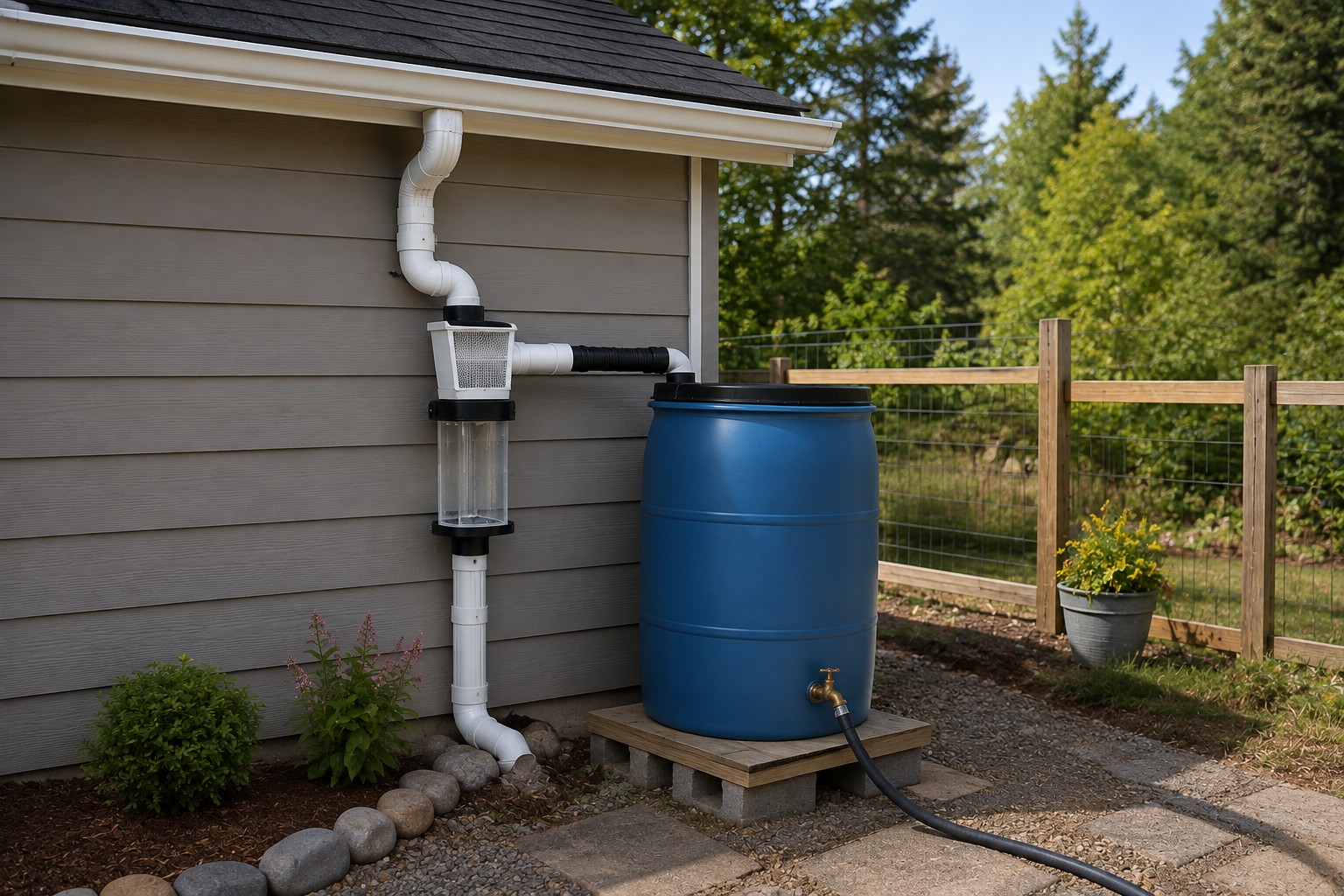
A gravity-fed rainwater system moves water through a simple sequence:
Roof Catchment → Gutters → Debris Screen → First-Flush Diverter → Storage Tank → Gravity Outlet → Non-Potable Use
Rain falling on the roof is directed into gutters and downspouts, where leaves and larger debris are screened out before the water reaches storage. A first-flush diverter can route the initial runoff away from the tank so that dust, pollen, bird droppings, and other roof contaminants are less likely to enter the stored supply.
The remaining runoff flows into a covered storage tank. If the tank is positioned above the point of use, gravity can move the stored water through a hose or dedicated outlet without an electric pump.
The system does not create pressure simply because the tank is large. Elevation is what creates gravity pressure, while pipe diameter, hose length, fittings, and restrictions affect flow.
Why Non-Potable Water Matters During a Water Outage
When municipal water service fails, stored drinking water becomes one of the household’s most valuable emergency resources. Using that supply for toilet flushing, cleanup, and other tasks can consume it much faster than expected.
A separate non-potable rainwater reserve allows households to preserve appropriately stored potable water for drinking, cooking, and other uses that require higher-quality water. Collected rainwater can instead support suitable sanitation and cleaning needs when properly managed for those intended uses.
Toilet flushing can be a particularly significant demand. Even a relatively efficient toilet used several times per day by multiple household members can consume many gallons of water each day. The Emergency Rainwater Supply Calculator above allows you to estimate that demand using your household size, expected flush frequency, and the actual gallons-per-flush rating of your toilet.
The objective is not to replace potable emergency water storage. It is to protect that supply by reserving drinking-quality water for the uses that truly require it.
How Much Rainwater Can Your Roof Collect?
The amount of rainwater available to your emergency system depends primarily on the roof area feeding the collection system and the amount of rainfall received.
A useful planning estimate is that 1 inch of rain falling on 1 square foot of roof produces approximately 0.62 gallons of water. Oregon State University Extension uses this relationship when estimating rainwater harvesting potential.
The basic calculation is:
Potential Rainwater Collection = Roof Catchment Area × Rainfall × 0.62
For example, a 1,000-square-foot roof catchment receiving 1 inch of rain has a theoretical collection potential of:
1,000 × 1 × 0.62 = 620 gallons
Actual captured water will be lower because some rainfall is lost through splash, gutter overflow, first-flush diversion, wetting of roof surfaces, and other collection inefficiencies. This is why the Emergency Rainwater Supply Calculator includes a collection-efficiency field rather than assuming every gallon reaching the roof enters the tank.
Storage capacity creates another practical limit. A system capable of capturing 500 gallons from a storm cannot store all of that water in a 300-gallon tank that was empty at the start of the storm.
Catchment determines how much water you could collect. Storage determines how much of that water you can keep. Household demand determines how long it may last.
Designing the Rainwater Collection Path
The roof is the collection surface for the entire system, so its size, material, condition, and surrounding environment influence both the quantity and quality of the rainwater reaching storage.
For collection calculations, use only the portion of the roof that actually drains into the gutters and downspouts connected to your rainwater system. A 2,000-square-foot roof does not provide 2,000 square feet of catchment if only half of it drains toward the storage tank.
Roof surfaces can also collect dust, pollen, leaves, bird and animal waste, and airborne contaminants between storms. Nearby trees, heavy wildlife activity, roofing condition, and long dry periods can increase the amount of material washed from the roof when rainfall begins.
The roof should therefore be treated as a catchment surface—not as a water-treatment system. Screening, first-flush diversion, protected storage, and appropriate use remain important parts of the system.
Gutters and Downspouts
Gutters and downspouts form the delivery path between the roof and the storage system. They must be able to move rainfall from the selected catchment area without excessive overflow during the storms you expect the system to capture.
Keep gutters reasonably clear of leaves, needles, sediment, and other material that can restrict flow or be carried toward the tank. Downspouts should direct collected water through the planned screening and first-flush components before it enters storage.
The route to the tank should also minimize unnecessary restrictions, low spots, and poorly supported sections where debris or standing water can accumulate. If several downspouts contribute to one storage system, the collection path must accommodate their combined flow.
A large storage tank provides little benefit if the gutters, downspouts, and inlet path cannot reliably deliver water to it.
Leaf and Debris Screening
The first stage of rainwater protection should remove larger debris before it reaches the storage tank. Leaves, twigs, insects, roofing particles, and other material can accumulate in stored water, restrict plumbing components, and increase tank maintenance.
Gutter guards can reduce the amount of large debris entering the collection path, while downspout screens or rain heads provide another opportunity to intercept material before water reaches the first-flush diverter and tank.
Screens should be accessible for inspection and cleaning. A screen that becomes clogged can restrict collection or cause water to overflow precisely when rainfall is available to refill the emergency supply.
Debris screening and first-flush diversion perform different jobs. Screening removes larger material; the first-flush system diverts the initial roof runoff that may contain smaller contaminants and accumulated surface debris.
First-Flush Diverter
The first rainfall reaching a roof after a dry period can carry a concentrated load of dust, pollen, bird and animal waste, roofing particles, and other material that accumulated on the catchment surface. A first-flush diverter redirects a portion of this initial runoff away from the storage tank.
Once the diversion chamber fills, subsequent runoff is directed toward storage. The diverter should also be able to drain or reset after the rain event so it is ready to capture the initial runoff from the next storm.
The appropriate diversion volume depends on factors such as roof area, roof condition, surrounding trees, accumulated debris, rainfall patterns, and the intended use of the collected water. For that reason, a single first-flush volume should not be treated as universally correct for every system.
The Emergency Rainwater Supply Calculator provides a planning range based on catchment area. Later in this guide, we will show exactly how that estimate is calculated and why actual system requirements may differ.
First-flush diversion improves the quality of water entering storage, but it does not make collected rainwater potable or eliminate the need for appropriate screening, storage, maintenance, and treatment when required.
Rainwater Storage Tank
The storage tank determines how much collected rainwater can actually be held for an emergency. Tank capacity should therefore be based on both collection potential and expected household demand, rather than simply choosing the largest container that fits the available space.
A rainwater tank should be protected from contamination and unnecessary light exposure. Inlets, vents, and overflows should be screened against insects and debris, and the tank should have a secure cover that prevents accidental access while allowing appropriate inspection and maintenance.
Tank location also matters in a gravity-fed system. Placing the tank higher than the intended point of use creates water pressure without electricity, while a tank sitting at or below the point of use may provide little or no useful gravity flow.
The weight of stored water must also be considered. Water weighs approximately 8.34 pounds per gallon, so a 275-gallon tank can contain roughly 2,294 pounds of water, excluding the tank itself. Large tanks require a stable, level base capable of supporting the full operating weight.
Storage capacity determines how much rainwater you can keep; tank elevation helps determine how effectively you can deliver it without a pump.
Tank Overflow
Once a storage tank is full, additional rainwater needs a controlled path away from the tank, its foundation, and nearby structures. An improperly planned overflow can cause erosion, saturated soil, foundation problems, or uncontrolled water discharge around the storage area.
The overflow outlet should be sized and positioned to handle incoming water when the tank has reached capacity. It should also be screened to help prevent insects, rodents, and debris from entering the tank through the overflow opening.
Depending on the property, overflow may be directed to an appropriate drainage area, infiltration feature, secondary storage tank, or another location where excess water can be safely managed. The discharge point should not undermine the tank base or simply return water against the building.
Overflow is not a minor accessory—it is part of the collection system. Every gallon entering a full tank must have somewhere appropriate to go.
How to Size a First-Flush Diverter
First-flush diverter sizing begins with the amount of roof area feeding the rainwater collection system. A larger catchment surface can accumulate more dust, pollen, animal waste, and other material between storms, so it generally requires a larger initial diversion volume.
There is no single first-flush volume that is correct for every rainwater system. Roof material and cleanliness, surrounding trees, local air quality, length of the dry period, rainfall intensity, and intended water use can all affect an appropriate diversion amount.
For preliminary planning, Texas A&M AgriLife Extension describes a general first-flush range of approximately 1 to 2 gallons for every 100 square feet of catchment area. The Emergency Rainwater Supply Calculator uses this range to provide an initial estimate.
The planning calculation is:
First-Flush Range = Roof Catchment Area ÷ 100 × 1 to 2 Gallons
For example, a 1,000-square-foot catchment produces a planning range of:
1,000 ÷ 100 × 1–2 gallons = approximately 10–20 gallons
That does not mean every 1,000-square-foot roof requires exactly 10–20 gallons of diversion. A relatively clean roof in one environment may require a different approach than a roof beneath heavy tree cover or one exposed to substantial bird activity and long dry periods.
The diverter also needs to reset between rain events. A chamber that remains full cannot properly divert the initial runoff from the next storm, so drainage and routine inspection are part of the design.
Use the calculator’s first-flush result as a planning range, then consider actual roof conditions, intended use, manufacturer guidance, and applicable local requirements before finalizing the system.
How Gravity Creates Water Pressure
A gravity-fed rainwater system does not need an electric pump to move water downhill, but the amount of usable pressure depends primarily on the vertical distance between the water level in the tank and the point where the water is being used. This vertical distance is commonly called head.
As a practical planning rule, every 2.31 feet of vertical water head produces approximately 1 psi of static pressure. Put another way:
Gravity Pressure (psi) ≈ Vertical Head (feet) × 0.433
For example, if the water surface in a tank is approximately 10 feet above an outdoor washing station:
10 × 0.433 ≈ 4.3 psi
That is far below typical municipal household water pressure, but it may still provide useful gravity flow for appropriate low-pressure applications.
Tank size should not be confused with pressure. A 500-gallon tank sitting at nearly the same elevation as the outlet does not automatically produce more pressure than a smaller tank positioned at the same height. Elevation creates static pressure; stored volume determines how much water is available.
Actual flow at the outlet will also be affected by hose or pipe diameter, line length, fittings, valves, filters, elevation changes, and other restrictions. A system can therefore have adequate static head but disappointing flow if water must travel through a long, narrow, or highly restricted line.
There is also an important difference between pressure and flow rate. Pressure describes the force available to move the water, while flow rate describes how much water actually passes through the system over time.
For emergency gravity supply, design around the actual point of use. Determine how far below the tank it is, what flow the intended task requires, and what restrictions exist between the tank and the outlet.
Manual Emergency Flushing
During a municipal water outage, a toilet may still be usable even though the normal water supply is unavailable. Stored rainwater can provide a separate non-potable water source for manual flushing, helping preserve drinking water for higher-priority uses.
For many conventional gravity-flush toilets, water can be supplied manually rather than through the normal pressurized household water line. The exact method depends on the toilet design, so homeowners should understand how their specific toilet operates before an emergency occurs.
Manual flushing has an important advantage for a basic preparedness system: the rainwater does not need to be permanently connected to the home’s potable plumbing. Water can remain in the dedicated rainwater storage system until it is needed for an appropriate non-potable use.
The amount consumed still matters. A household of four using a 1.6-gallon toilet four times per person each day could require:
4 people × 4 flushes × 1.6 gallons = 25.6 gallons per day
That demand can deplete a small rain barrel quickly, which is why the calculator above considers both household toilet use and available storage.
If emergency toilet flushing is one of your primary rainwater uses, calculate the demand before choosing the storage capacity—not after the outage begins.
Dedicated Rainwater Supply to a Toilet
A more permanent rainwater system can be designed to supply a toilet cistern through a dedicated non-potable water line. This can make stored rainwater easier to use during an extended outage, but it is fundamentally different from carrying rainwater to a toilet for manual emergency flushing.
A dedicated system must provide enough pressure and flow for the toilet’s fill mechanism to operate properly. A gravity-fed tank may be capable of doing this when sufficient elevation exists, but a tank located only slightly above the toilet may not provide adequate performance. The requirements depend on the toilet, tank elevation, piping, valves, filters, and other restrictions in the system.
More importantly, connecting collected rainwater to plumbing inside a home introduces cross-connection and water-quality considerations. Non-potable rainwater must not be allowed to contaminate the potable water system.
Plumbing codes and rainwater requirements vary by location. Depending on the jurisdiction and system design, requirements may include permits, approved backflow or cross-connection protection, labeling, filtration or treatment, dedicated piping, inspections, and professional design or installation.
The U.S. Environmental Protection Agency maintains resources covering onsite non-potable water reuse and state-level requirements for applications including rainwater reuse.
Do not treat a gravity-fed rainwater connection to a toilet as simply attaching a hose from the tank to the toilet supply. Before permanently connecting rainwater to indoor plumbing, determine the applicable local requirements and have the system designed or reviewed by a qualified plumbing professional when required.
For a basic emergency-preparedness system, manual toilet flushing provides a much simpler way to use stored rainwater without creating a permanent connection between the rainwater system and household plumbing.
Using Rainwater for Emergency Hygiene and Washing
Stored rainwater can also extend household water reserves by supplying appropriate non-potable cleaning and sanitation tasks during an extended water outage. A simple gravity-fed outlet or outdoor washing station can make this water accessible without relying on an electric pump.
Potential uses may include cleaning tools and equipment, rinsing outdoor surfaces, preliminary cleanup, and other tasks that do not require drinking-quality water. Keeping these demands separate from the household’s potable supply can substantially reduce the amount of stored drinking water consumed during an outage.
Use greater caution when rainwater could contact people, food, dishes, or food-preparation surfaces. Roof runoff can contain microorganisms, animal waste, chemicals, and other contaminants that are not necessarily removed by debris screening or first-flush diversion.
For that reason, untreated collected rainwater should not automatically be considered suitable for handwashing, bathing, brushing teeth, washing dishes, food preparation, or other uses where contaminated water could create a health risk. Appropriate treatment depends on the intended use and applicable public-health guidance.
An outdoor gravity-fed wash point can still be valuable for suitable non-potable tasks. Positioning the outlet below the tank, using adequately sized hose or piping, and minimizing unnecessary restrictions will improve gravity flow.
The preparedness value of rainwater is not that it makes every household water use possible. It is that it can shift appropriate non-potable demands away from the limited supply of water you have stored for drinking and other essential uses.
Keeping Stored Rainwater Suitable for Non-Potable Use
Keep Light, Debris, and Animals Out
Rainwater quality can deteriorate after collection if the storage system allows sunlight, debris, insects, or animals to enter. Good storage design therefore matters even when the water is intended only for non-potable emergency uses.
Use a covered, opaque or light-blocking tank whenever practical. Limiting sunlight helps discourage algae growth, while a secure cover reduces the chance that debris, animals, or other contaminants will enter the stored supply.
Tank inlets, vents, and overflow openings should be appropriately screened. Screening is particularly important for helping prevent mosquitoes and other insects from entering the tank while still allowing the system to fill, vent, and overflow properly.
The area around the tank should also be kept reasonably clean so that maintenance access, fittings, screens, and overflow components can be inspected without introducing unnecessary contamination.
A rainwater tank is part of the water-management system, not simply a container. Protecting what enters the tank—and what can enter it after collection—is essential to maintaining a useful emergency reserve.
Manage Sediment and Inspect the Tank
Even with gutter screening and first-flush diversion, small particles can eventually reach the storage tank and settle to the bottom. Over time, accumulated sediment can affect water quality, obstruct outlets, and make the system more difficult to maintain.
Design the system so the tank, inlet screens, outlet fittings, and other components can be inspected without dismantling the entire installation. Periodically check for sediment buildup, damaged screens, algae, insects, leaks, blocked fittings, and unusual odors or visible changes in the stored water.
Avoid positioning the primary outlet where it will continually draw from accumulated bottom sediment. Tank design and outlet configuration vary, but keeping settled material away from the normal withdrawal point can reduce the amount carried into hoses and downstream components.
Cleaning frequency will depend on the roof environment, effectiveness of pre-storage screening, tank design, rainfall patterns, and how frequently the system is used. A system beneath heavy tree cover may require more attention than one supplied by a relatively clean catchment.
The best time to discover a blocked outlet, damaged screen, or contaminated tank is during routine inspection—not during a municipal water outage.
Maintain Screens, Diverters, and Overflow
A rainwater system depends on several components working together, and many of the most important maintenance points are located before water ever reaches the tank.
Inspect gutter guards, leaf screens, downspout filters, and other debris-control components periodically and remove accumulated material that could restrict water flow. Pay particular attention before seasons when heavy rainfall is expected.
The first-flush diverter should also be checked to confirm that it drains and resets properly between rain events. A clogged drain or diverter that remains full may allow the initial runoff from the next storm to flow directly toward storage.
Inspect the tank overflow for obstructions and confirm that its insect screening remains intact. Water should be able to leave a full tank freely and discharge to the intended location without eroding the tank base or directing water toward the building.
Valves, hoses, fittings, and gravity outlets should occasionally be operated as well. Components that remain unused for long periods can leak, clog, deteriorate, or become difficult to operate.
Treat the system like other emergency equipment: periodically inspect and operate it before you actually need to depend on it.
What a Gravity-Fed Rainwater System Cannot Do
A gravity-fed rainwater system can strengthen household water resilience, but it has important limitations. Understanding those limitations prevents the system from being expected to do more than it was designed to accomplish.
- It does not automatically produce drinking water. Roof runoff can contain microorganisms, animal waste, chemicals, roofing contaminants, and other pollutants. Collection, screening, and first-flush diversion do not by themselves make rainwater potable.
- It does not provide normal household water pressure. Gravity pressure depends primarily on elevation. A tank located only a few feet above an outlet will produce substantially less pressure than a typical municipal water supply.
- It cannot supply more water than the system collects and stores. A large household demand can empty a small tank quickly, regardless of how well the collection system is designed.
- It cannot guarantee water will be available when needed. Rainfall is variable. Emergency planning should not assume that a storm will arrive immediately before or during a water outage.
- It does not eliminate the need for stored potable water. Rainwater can preserve drinking-water reserves by handling appropriate non-potable tasks, but households should still maintain a dedicated potable emergency supply.
- It does not make permanent indoor plumbing connections automatically safe or code-compliant. Cross-connection protection, treatment, dedicated piping, permits, inspections, and professional installation may be required depending on the system and jurisdiction.
- It does not overcome poor maintenance. Clogged screens, a first-flush diverter that does not reset, contaminated storage, blocked outlets, or damaged overflow components can reduce the usefulness of the system when it is needed most.
Think of harvested rainwater as one layer of household water security—not as a replacement for every other emergency water measure.
Common Rainwater Harvesting Mistakes
A rainwater system can look simple—roof, gutter, tank, outlet—but several planning mistakes can substantially reduce its usefulness during an emergency.
- Buying a tank before calculating catchment and demand. Storage should reflect how much water the roof can realistically collect and how quickly the household is likely to use it.
- Counting the entire roof as catchment area. Include only the roof surfaces that actually drain into the collection system.
- Ignoring debris before it reaches the tank. Leaves, roofing particles, insects, and other material are easier to intercept before they enter storage.
- Skipping first-flush planning. The initial runoff after a dry period can carry accumulated material from the roof into the system.
- Assuming collected rainwater is automatically clean. A clear-looking tank does not mean the water is potable or appropriate for every household use.
- Confusing tank size with water pressure. A larger tank stores more water, but useful gravity pressure comes primarily from elevation.
- Using narrow or unnecessarily long gravity lines. Hose diameter, length, fittings, filters, and elevation changes can substantially restrict flow.
- Ignoring overflow. A full tank must have a controlled path for additional incoming water that does not undermine the tank or threaten nearby structures.
- Failing to protect tank openings. Inlets, vents, and overflow openings can provide entry points for mosquitoes, insects, animals, and debris if they are not appropriately protected.
- Depending on rainfall instead of maintaining potable water storage. Rainwater availability is weather-dependent and should complement—not replace—a dedicated emergency drinking-water supply.
- Making permanent indoor plumbing connections without checking requirements. Non-potable rainwater systems can involve cross-connection protection, treatment, permits, labeling, inspections, or professional installation depending on local rules.
- Building the system and then forgetting about it. Screens clog, diverters stop draining, fittings deteriorate, and sediment accumulates. Emergency equipment needs periodic inspection.
A useful emergency rainwater system is not necessarily complicated. It is simply planned around collection, storage, gravity delivery, appropriate water use, and routine maintenance as one complete system.
Emergency Gravity-Fed Rainwater System Checklist
Before relying on a rainwater system during a municipal water outage, use this checklist to confirm that the major parts of the system have been considered:
- Identify the intended uses. Decide whether stored rainwater will support toilet flushing, outdoor cleanup, equipment washing, or other appropriate non-potable tasks.
- Determine the actual roof catchment area. Count only the roof surfaces that drain into the collection system.
- Estimate collection potential. Use roof area, expected rainfall, and realistic collection efficiency to determine how much water may reach storage.
- Calculate household demand. Estimate toilet-flushing requirements and other planned non-potable water use.
- Size storage appropriately. Compare expected collection with daily demand rather than selecting tank capacity arbitrarily.
- Plan debris screening. Keep leaves, insects, roofing particles, and other larger material from entering storage.
- Plan first-flush diversion. Estimate an appropriate initial diversion volume and make sure the diverter can reset between storms.
- Choose the tank location carefully. Consider structural support, access, sunlight, overflow, and the elevation needed for useful gravity delivery.
- Plan the gravity outlet. Minimize unnecessary restrictions and consider hose or pipe diameter, length, fittings, and the elevation of the point of use.
- Provide controlled overflow. Give excess rainfall a safe discharge path once the tank reaches capacity.
- Protect and maintain the stored water. Inspect screens, tank openings, sediment, fittings, valves, diverters, and overflow components periodically.
- Verify requirements before connecting to indoor plumbing. Permanent non-potable plumbing may require permits, treatment, cross-connection protection, labeling, inspections, or professional installation.
- Maintain separate potable water storage. Do not depend on rainfall as the household’s only emergency water supply.
A well-designed system starts with the household’s actual water needs, then works backward through storage, gravity delivery, collection, and rainfall to determine what the system can realistically provide.
Frequently Asked Questions About Gravity-Fed Rainwater Systems
How much rainwater can I collect from my roof?
The amount of rainwater you can collect depends primarily on the roof area feeding the system, rainfall, and collection efficiency.
As a planning estimate, 1 inch of rainfall on 1 square foot of roof produces approximately 0.62 gallons of water. A 1,000-square-foot catchment receiving 1 inch of rain therefore has a theoretical collection potential of approximately 620 gallons.
Actual collection will be lower because of roof wetting, splash, gutter losses, first-flush diversion, overflow, and other inefficiencies. Storage capacity can also limit how much of the available rainfall you keep.
Use the Emergency Rainwater Supply Calculator above to estimate collection using your roof area, rainfall, collection efficiency, and tank capacity.
Can you flush a toilet with rainwater during a water outage?
Yes. Collected rainwater can provide a useful non-potable water source for emergency toilet flushing when municipal water service is unavailable.
For a basic emergency system, rainwater can be stored separately and used for manual toilet flushing, avoiding a permanent connection between the rainwater supply and household potable plumbing. This can help preserve stored drinking water for drinking, cooking, and other higher-priority uses.
A permanently installed system that automatically supplies a toilet is more complex. It may require dedicated non-potable piping, cross-connection or backflow protection, filtration or treatment, labeling, permits, inspections, or professional installation depending on local requirements.
For emergency preparedness, manual flushing is generally the simplest way to use stored rainwater for toilet sanitation without modifying the home’s plumbing system.
How much water does toilet flushing use during an outage?
Daily toilet-flushing demand depends on the number of people in the household, how frequently the toilet is flushed, and the toilet’s gallons-per-flush rating.
For example, a household of four using a 1.6-gallon toilet four times per person per day would require:
4 people × 4 flushes × 1.6 gallons = 25.6 gallons per day
Over a seven-day water outage, toilet flushing alone could consume approximately 179 gallons at that usage rate. Older or less efficient toilets may use considerably more water per flush, while conservation measures during an emergency can reduce total demand.
This is why toilet use should be calculated before choosing rainwater storage capacity. A typical rain barrel may hold enough water for only a few days of normal flushing in a larger household.
Use your toilet’s actual gallons-per-flush rating in the Emergency Rainwater Supply Calculator to estimate your household’s daily demand and how long the stored supply may last.
Does a rainwater tank need electricity?
No. A rainwater storage tank itself does not require electricity, and a properly designed gravity fed rainwater system can deliver stored water without an electric pump when the tank is sufficiently elevated above the point of use.
The available pressure depends primarily on the vertical distance between the water level in the tank and the outlet. As a planning rule, each foot of vertical head produces approximately 0.433 psi of static pressure.
Electricity may be required when a system uses pumps, powered treatment equipment, automatic controls, or needs to provide pressures that gravity alone cannot produce. Those components can improve performance, but they also introduce dependence on electrical power.
For emergency preparedness, gravity delivery offers an important advantage: appropriately stored water can remain accessible even during an extended grid outage.
How high does a rainwater tank need to be for gravity feed?
There is no single required tank height because the necessary elevation depends on the pressure and flow required at the point of use.
As a planning rule, every 2.31 feet of vertical head produces approximately 1 psi of static water pressure. A water surface 10 feet above an outlet therefore provides approximately 4.3 psi, while 20 feet provides approximately 8.7 psi before accounting for friction and other system losses.
Measure vertical head from the water level in the tank to the point of use, not simply from the bottom of the tank to the ground. As the tank empties and the water level falls, available gravity pressure also decreases.
Hose or pipe diameter, line length, fittings, valves, filters, and elevation changes can further reduce actual flow at the outlet.
The tank does not need to reach normal household water pressure to be useful. It needs enough elevation and unrestricted flow to perform the specific emergency task the system is designed to support.
How much pressure does a gravity-fed water tank produce?
Gravity-fed water pressure is determined primarily by the vertical distance between the water surface in the tank and the point of use.
A useful planning relationship is:
Pressure (psi) ≈ Vertical Head (feet) × 0.433
For example:
5 feet of head ≈ 2.2 psi
10 feet of head ≈ 4.3 psi
20 feet of head ≈ 8.7 psi
30 feet of head ≈ 13.0 psi
These figures represent approximate static pressure. Actual flow at an outlet will be affected by hose or pipe diameter, length, fittings, valves, filters, and other restrictions.
A larger tank does not inherently create higher pressure. If two tanks have the same water-surface elevation relative to the outlet, their static gravity pressure will be approximately the same even if one holds substantially more water.
Tank volume determines how much water is available. Vertical head determines the gravity pressure available to move it.
What is a first-flush diverter?
A first-flush diverter is a component that redirects the initial runoff from a roof away from the rainwater storage tank. This first portion of rainfall can carry dust, pollen, bird and animal waste, roofing particles, and other material that accumulated on the catchment surface between storms.
Once the selected diversion volume has been collected, subsequent roof runoff is allowed to continue toward the storage tank.
First-flush diverters typically need a way to drain and reset after the rain event. If the diversion chamber remains full, it may not capture the initial runoff from the next storm.
The appropriate diversion volume depends on the roof area, catchment conditions, surrounding environment, rainfall patterns, and intended use of the collected water.
A first-flush diverter can reduce the amount of accumulated roof contamination entering storage, but it does not make rainwater potable or replace appropriate screening, storage, maintenance, or treatment.
How big should a first-flush diverter be?
There is no universal first-flush diverter size that is correct for every rainwater collection system. The appropriate volume depends on roof catchment area, roof condition, surrounding trees and wildlife, accumulated debris, local rainfall patterns, and the intended use of the collected water.
For preliminary planning, a range of approximately 1 to 2 gallons of diversion for every 100 square feet of roof catchment can be used as an initial estimate.
For example, a 1,500-square-foot catchment would produce a planning range of:
1,500 ÷ 100 × 1–2 gallons = approximately 15–30 gallons
This is a planning estimate rather than a universal design requirement. Local guidance, system specifications, and actual catchment conditions may justify a different diversion volume.
Use the first-flush result in the Emergency Rainwater Supply Calculator as a starting point, then evaluate the conditions of your actual roof and collection system before finalizing the diverter size.
Is rainwater safe for washing?
It depends on what is being washed and how the rainwater has been collected, stored, and treated. Roof-collected rainwater should not automatically be considered clean simply because it looks clear.
Roof runoff can contain microorganisms, bird and animal waste, chemicals, roofing residues, and other contaminants. Debris screening and first-flush diversion can reduce some contamination entering storage, but they do not necessarily make untreated rainwater appropriate for every washing or hygiene use.
Untreated stored rainwater may be useful for suitable non-potable tasks such as cleaning tools, rinsing outdoor equipment, or washing exterior surfaces. Greater caution is appropriate when water will contact hands, the body, dishes, food, or food-preparation surfaces.
Do not assume untreated rainwater is safe for bathing, handwashing, brushing teeth, washing dishes, or food preparation. The appropriate water quality and treatment depend on the intended use and applicable public-health guidance.
Can rainwater be connected directly to household plumbing?
Rainwater can be incorporated into household plumbing through a properly designed non-potable water system, but it should not simply be connected directly to the home’s potable water piping.
A permanent rainwater supply for toilets or other indoor fixtures may require dedicated non-potable piping, cross-connection or backflow protection, filtration or treatment, labeling, permits, inspections, and professional design or installation. Exact requirements vary by jurisdiction and by how the collected water will be used.
The primary concern is preventing untreated or inadequately treated rainwater from entering the potable water system. A connection that allows non-potable water to flow into drinking-water plumbing can create a serious contamination hazard.
For emergency preparedness, keeping rainwater storage physically separate from household potable plumbing and using the water manually for appropriate non-potable purposes is considerably simpler.
Before permanently connecting a rainwater system to any indoor plumbing, check local plumbing and public-health requirements and use a qualified professional when required.
Build Your Emergency Rainwater System Around Real Household Needs
A useful gravity fed rainwater system begins with a simple question: What non-potable water needs would become difficult to meet if municipal water service stopped?
For many households, emergency toilet flushing and basic cleanup can consume substantial amounts of water. Collecting roof runoff provides a way to shift appropriate non-potable demands away from the limited drinking water stored for drinking, cooking, and other essential uses.
Start by calculating your roof catchment potential and expected household demand. Then determine the storage capacity, debris screening, first-flush diversion, tank elevation, gravity delivery, overflow, and maintenance required to make that water realistically accessible during an outage.
The system does not need to reproduce normal household plumbing to be valuable. A relatively simple collection and storage system can provide meaningful water resilience when it is designed around what the household actually needs and what gravity can realistically deliver.
Foundation Readiness approaches emergency water as a complete household system: maintain a dedicated potable water reserve, develop appropriate methods for obtaining and treating additional water when necessary, and use non-potable resources intelligently so drinking-quality water is not wasted on tasks that do not require it.
The goal is not simply to collect rainwater. It is to turn available rainfall into a practical second layer of household water security when normal water service is unavailable.